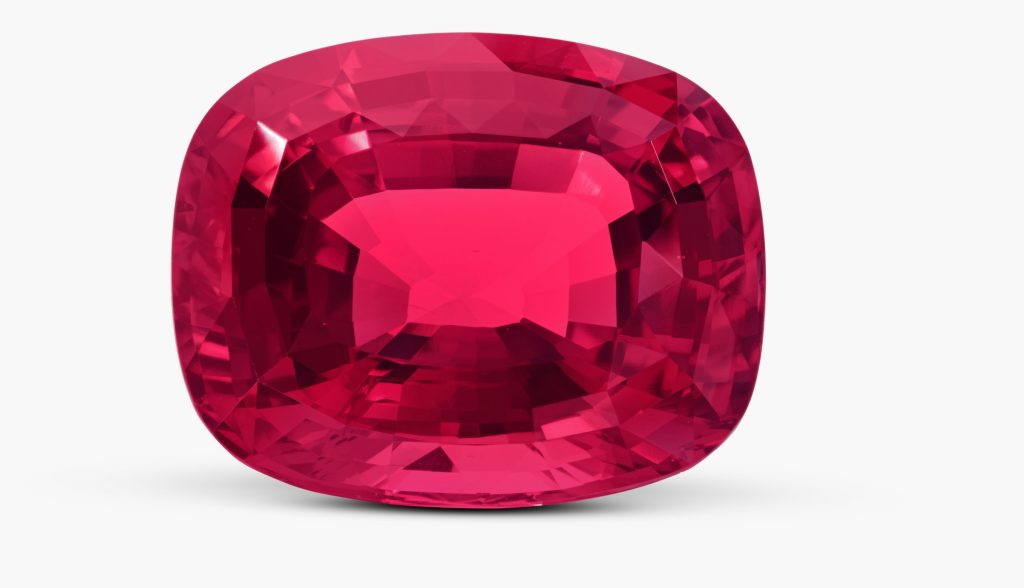
The acquisition of an exceptional 51.79-carat spinel by Alisa Moussaieff, owner of legendary jeweller Moussaieff, has provided the clearest signal yet that the once-overlooked gemstone is entering a new era of appreciation.
The unmounted Tanzanian stone sold for CHF1.66 million at Sotheby’s Geneva last week, more than three times its CHF500,000 high estimate. After acquiring it, the principal of Moussaieff Jewellers named it the Moussaieff Spinel, giving the gemstone an identity, which is a practice more commonly associated with exceptional diamonds, rubies and sapphires.
For spinel – red varieties of which spent centuries being mistaken for rubies, and which for much of the modern era has been overlooked by serious jewellery collectors – the sale marks how far its status has travelled.
“I was immediately drawn to this exceptional spinel, whose extraordinary colour brought to mind the great historic spinel in the British Crown Jewels,” Moussaieff said in a statement released by Sotheby’s this week. “At a time when gemstones of the finest quality are becoming increasingly scarce, collectors are also looking beyond the traditional triumvirate of rubies, sapphires and emeralds, and recognising the rarity and importance of exceptional spinels.”
With a price-per-carat of approximately $38,184, the Mousaieff Spinel appears to have established a new auction record for a single spinel, surpassing the approximately $29,000-per-carat benchmark set by the Hope Spinel at Bonhams in 2015. The record for a spinel jewel appears to remain with an Imperial Mughal necklace containing 11 spinels, sold by Christie’s for $5.2 million in 2011.
From hidden gem to hot ticket
Spinel’s rise did not begin with a single auction. Prices have increased by as much as 15% annually over the past decade, according to figures reported by the Financial Times, as restricted supplies of exceptional natural gemstones have encouraged collectors to look beyond rubies, sapphires and emeralds.