

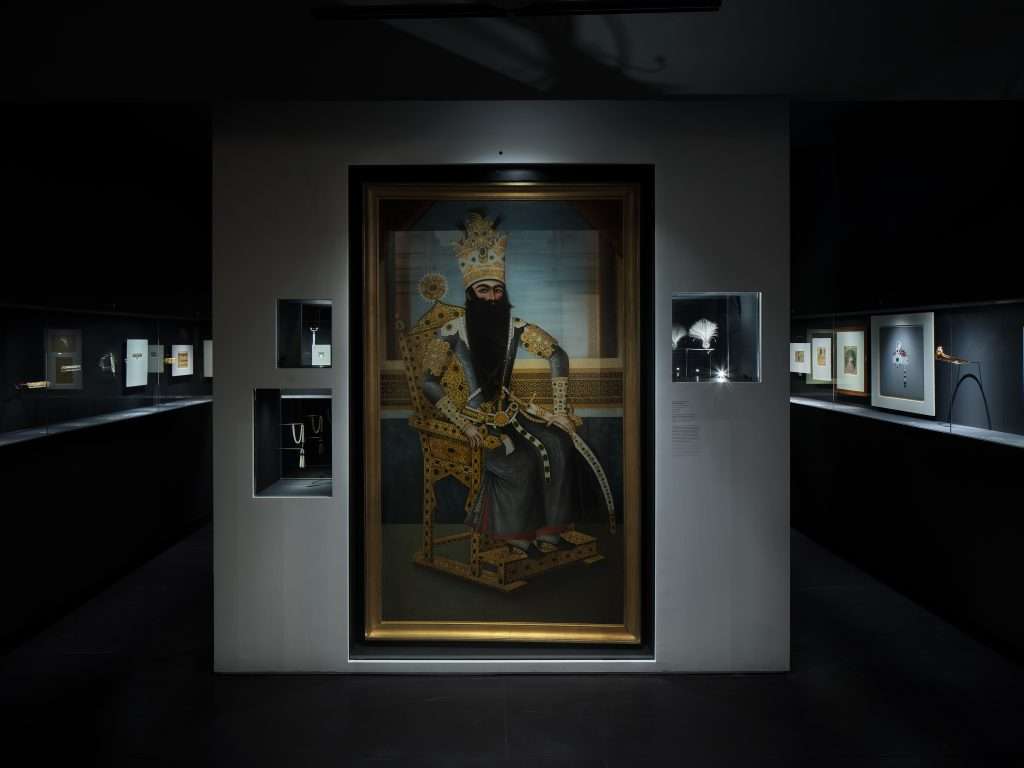
If I thought I understood Art Deco style, its drivers, influences and references, then I was in for a big surprise. Or more like a revelation. The milestone exhibition – Cartier and Islamic Art – In Search of Modernity, at the Musée des Arts Décoratifs, Paris (until February 20th 2022) , co-organised with the Dallas Museum of Art (where it opens in May) explores the formative influence of Islamic art on Cartier’s High Jewellery from the early 20th century up to the present day. The revelation came from seeing and understanding, in ravishing detail, just how the richness and complexity, the mysticism, meanings and sophistication of Islamic art, decorative art and architecture exerted such a profound influence that it has shaped the Maison’s distinctive visual vocabulary through a century and more. There was revelation too in seeing just how Islamic art fuelled 20th century modernism, through geometry, form, patterns and colour combinations, many of them ancient, archetypal and yet totally timeless.

As far as cultural inspirations go, this is – for us civilians at least – virgin territory. We’ve delved into Cartier’s design history, into influences from China, Egypt, Japan, we’ve dipped into the non-specific fashionable Orientalism of the Ballets Russes, the French 18th century classicism of Belle Epoque ‘garland style’, and we know all about the Indian-flavoured Tutti Frutti carved coloured gems, revisited in Cartier’s contemporary collections. Yet until now, no such in-depth investigation has been undertaken into the enduring impact of Islamic art on Cartier style, nor into Louis Cartier’s personal fascination with the subject, his connoisseurship and scholarly collection of Islamic masterpieces, some of which, now in the Louvre, feature in this exhibition. It has taken the combined expertise, knowledge and academic research capabilities of esteemed curators from the Musée des Arts Décoratifs and the Dallas Museum of Art, in a special collaboration with the Louvre, and with support from Cartier and its archives to embark on this cultural adventure. Through more than 500 exhibits – jewels, objects, drawings, books, photographs and archival documents, including pages from Louis Cartier’s notebooks – this sumptuous visual feast of a show-and-tell extravaganza traces the course of Islamic artistic influence on Western jewellery design, and its pivotal contribution to modernism.
Geometry crept into Cartier’s design books as early as 1904, as the manic wave of Orientalism was sweeping through fashion, interiors and decorative design, and at a time when Paris was becoming the centre of the trade in Islamic works of art. As the Ottoman Empire disintegrated, communities drifted west, across Europe, often carrying their treasures with them as currency for a new life, objects which were then traded by antiquities dealers. Museum exhibitions showcased Islamic art, and around 1912, Cartier organised its own exhibitions dedicated to Eastern jewellery and objects. So that it is from this era, as the exhibition shows us, that Islamic shapes, motifs and patterns, colours and materials insinuated themselves into European design to become the building blocks of the style that came to be called Art Deco.
The first section of the exhibition takes the visitor through Cartier’s creative process, the precise sources of inspiration, along with books from Louis Cartier’s library and masterworks from his collection, including the spectacular inlaid ivory pen boxes of Shah Abbas of Persia, a ravishing 17th century Mughal jade and jewelled sprinkler, and 16th century Mughal painted miniatures. Here too are Louis’s notebooks -adding a note of intimacy – and pages from the sketchbook of Charles Jacqueau, Cartier’s chief designer and architect of the Maison’s distinctive Art Deco style. Amongst the dazzling jewels related to these sources of inspirations, is Merle Oberon’s ravishing 1938 diamond and emerald-fringed necklace – breath-taking to see one of my all-time favourite jewels up close and personal.
The section presents fascinating, and revelatory, specific source references for some of Cartier’s most iconic masterpieces, such as the 1924 vanity case, inlaid with mother-of-pearl and turquoise, set with carved emeralds and edged in pearls, shown alongside a 19th century Persian wood and marquetry casket; and painted designs for a powder compact, clearly inspired by a vibrantly coloured ceramic mosaic fragment of architectural decoration, also from Iran, late 14th to 15th century and in the Louvre’s collection.
The exhibition then takes us onto the story of Jacques Cartier’s travels in India, including his visit to the 1911 Delhi Durbar, his meetings with Maharajahs, and his encounter with gem and pearl dealers and the carved gems that were the genesis of the celebrated Tutti Frutti style. After a dazzling and palette-cleansing display of Cartier Belle Epoque all-diamond jewels, and an exploration of until-now-unrecognised influences, the second section of the exhibition is dedicated to the forms, motifs, patterns, to art and architecture and objects of Islamic art drawn from the collections of the Musée des Arts Décoratifs and the Louvre. Here are enamelled brick decorations, architectural ornamentation, bookbindings, Iznik tiles, textiles, and the stepped or ‘terraced’ merlons that became a defining geometric feature of Art Deco; here are the fleurons, palmettes, drops, ellipses, tassels, scrolls and scales, and the wavy pattern signifying water, that translated into a stunning Cartier diamond tiara of 1902 and a diamond pendant on pearl sautoir; and here too we see the inspiration for combinations of colours and materials, jade, lapis and turquoise that were considered so new, avant-garde and radical in the early 20th century.
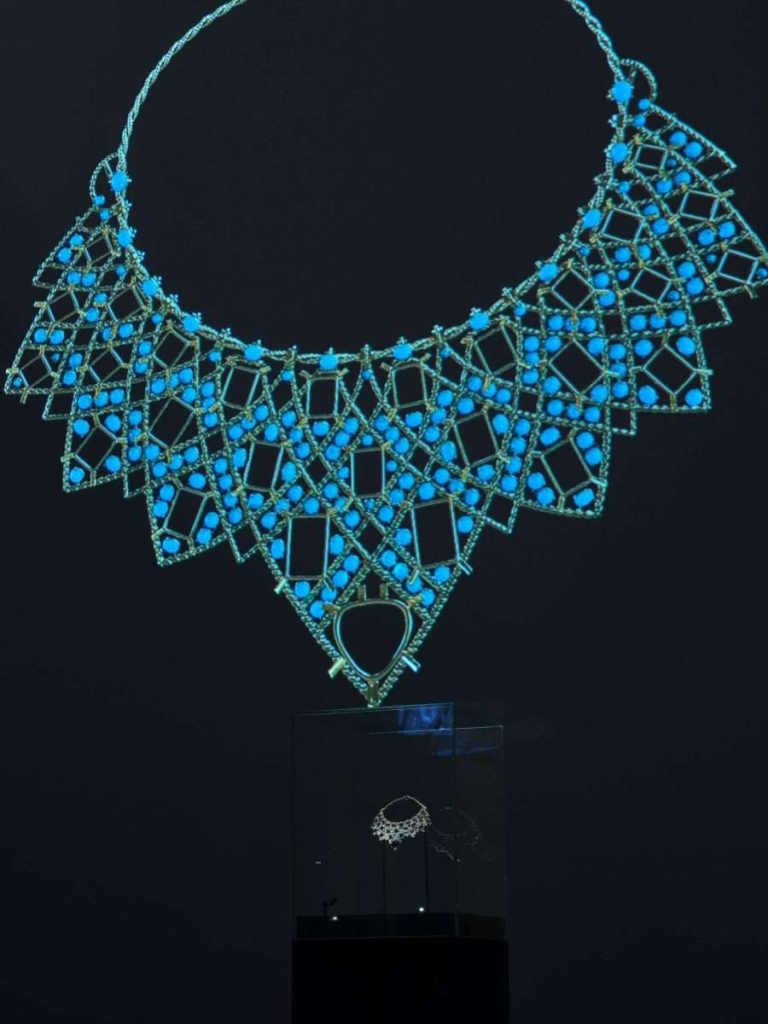
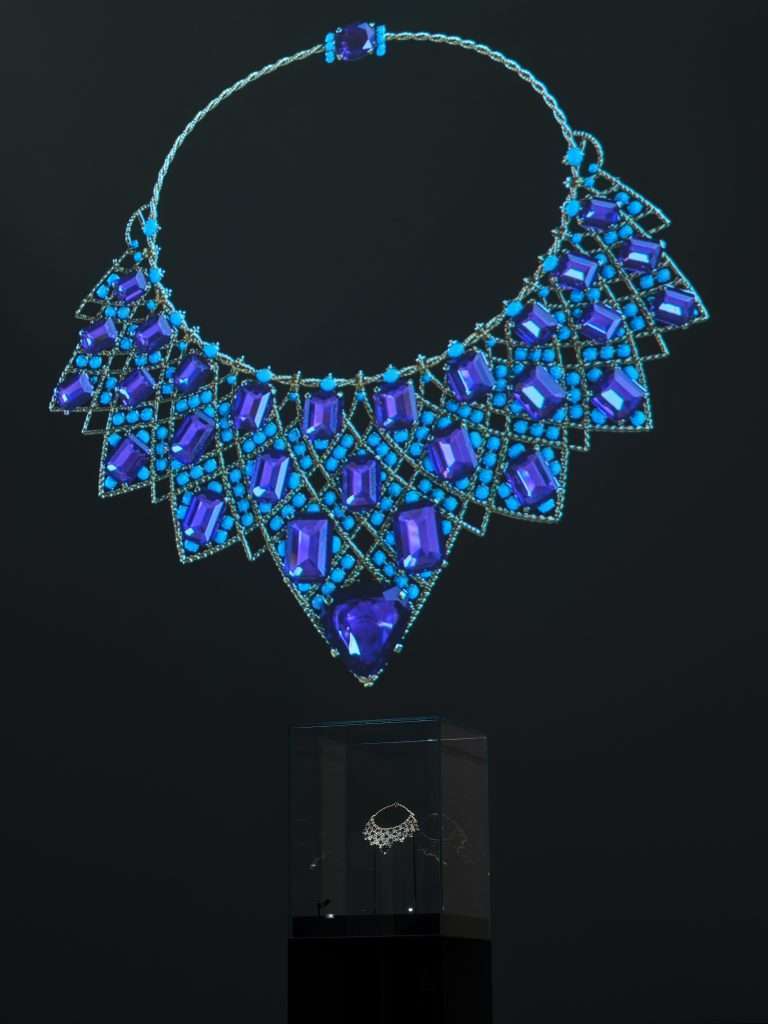
In the 1930s, Cartier’s celebrated Directrice of High Jewellery, Jeanne Toussaint found her own individualistic expression of exoticism, especially for Indian-inspired jewels that were all the rage at the time amongst the social glitterati and fashion elite. These famous Cartier clients includd Marjorie Merriweather Post, whose sumptuous diamond pendant, centred on a 17thcentury carved emerald is on display, alongside the most famous Tutti Frutti creation, Daisy Fellowes’ exuberant ‘collier hindou’ and just as famous, the Duchess of Windsor’s startling amethyst and turquoise bib necklace, of 1947. Last, a showcase presents a lone Cartier diamond openwork necklace from 2000, inspired by a 1948 necklace composed of shimmering gold sequins and labelled at the time by Femina magazine as a prime example of “Le style oriental des bijoux nouveaux.” Inside the vitrine the modern diamond necklace, light as a magical web, rises and falls, as if on a breathing decolletage, to demonstrate its sensuality and fluidity, and perhaps too to show that the influence of Islamic art is a living, breathing inspiration, and one of the most potent and enduring ingredients of Cartier’s inimitable jewellery style.
Read more about the Cartier story


