An office located on the side of a roundabout in Stroud, Gloucestershire seems like an odd location for Britain’s biggest eco-company. But this small provincial English market town is not only home to Ecotricity, founded by eco-entrepreneur Dale Vince in 1995, but also its sister companies – Ecojet, The Devil’s Kitchen (a plant-based burger company) and, now, Skydiamond, Vince’s sky-mining company which converts atmospheric carbon into lab-made diamonds.
Vince, the eccentric owner, is an ex new-age traveller: his hair is cut in a directional mohawk, he has lightning-bolt ear piercings, wears ripped jeans and a Philipp Plein jacket complete with a “Fuck You” logo and pirate insignia.

The offices also bear more than a passing resemblance to those of Wernham Hogg, the fictional paper mill from the British comedy The Office. When I arrive on a chilly late November morning, I can hear the theme tune jingling in my head. A greened-out Union Jack hangs above the main entrance and an electric motorbike is parked on charge in the company’s garages in a bay marked “Dale”. Other than that, there are few visual clues that this office block is the headquarters of Britain’s greenest company. Even the lobby is minimalist and offers few hints—the industrial standard office carpet is, of course, green, and there’s a glass cabinet of awards for Ecotricity as well as a sign that reads “proud to be badger friendly.”
It’s only when I move into Vince’s office itself that the space starts to feel distinctly more personal. From the walls hangs a skull and crossbones flag from the Greenpeace ship Sea Shepherd, another green Union Jack, a graffiti painting of the late Queen Elizabeth II, as well as a sign for Ecotricity and a Forest Green Rovers F.C. football shirt. Taking up most of the space in his office, and laid out like the musings of a Bond villain, is a to-scale plan of a new eco-industrial park that he’s planning to build off the M5 which will be home to his football club, Forest Green Rovers, the Ecotricity company HQ, as well as the various factories for his businesses.
In the 1980s, Vince spent 10 years living on the road in a converted bus and fire truck, and it was this type of lifestyle that taught him how to look for creative solutions in the face of huge obstacles. His first and main business, Ecotricity, was built from a wind turbine that was created to power his computer and mobile phone in his caravan.

Vince greets me in his office. He’s casual and friendly, telling me I can “take pictures of anything you like.” Vince founded the Global Green Energy Movement in 1995 with the launch of Ecotricity, the UK’s first green energy company that harnessed power from wind turbines instead of fossil fuels. Today, Ecotricity powers more than 200,000 homes and businesses across the UK with renewable energy from the wind and sun. To kickstart the electrification of transport in 2011, he created the Electric Highway, the world’s first national charging network for electric cars, which he recently sold to become Europe’s first for EVs. In addition to owning Devil’s Kitchen, which creates vegan school dinners, he was executive producer of the Netflix documentary Seaspiracy. He also became a United Nations Climate Champion in 2018 and launched his book, Manifesto, in 2020. “We used to say whether it’s burgers, cars or football, there’s another way,” he tells me. “We built Britain’s first electric car, for example, the world’s first carbon neutral football club and all that kind of stuff. And now we’ve added diamonds to the end of the list.”
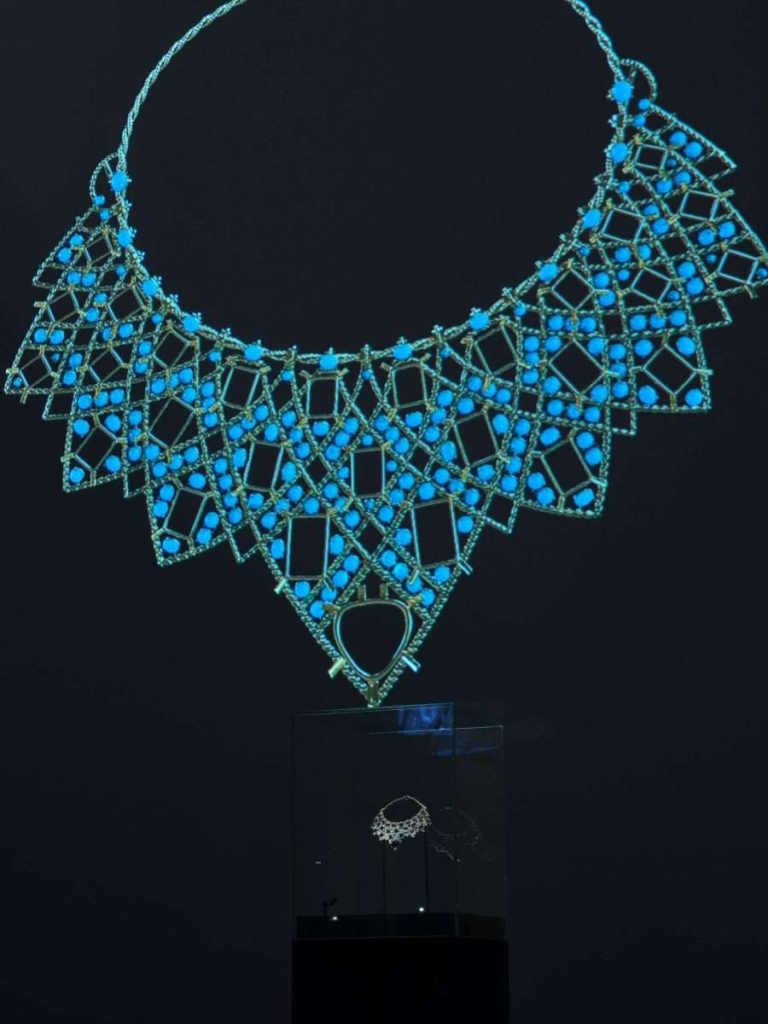
In addition to the companies previously mentioned, Vince also owns a luxury jewellery company, Skydiamond—a company that couldn’t seem more at odds with his eco credentials. Skydiamond harnesses power from his wind turbines to capture carbon from the air and turn it into diamonds. “I did hope that we could make diamonds super cheap through our invention, but that’s not turned out to be the case,” he explains. His initial plan was simple, he says: “giving bags of diamonds to companies to offset their carbon emissions.” However, this idealistic endeavour proved impossible to achieve as the real cost of creating the diamonds—in terms of power, materials, and human cost—was enormous. All diamonds were previously mined, having been formed by incredible forces of heat and pressure millions of years ago. Since 1954, diamonds for industrial use have been created in a lab by mimicking those same forces. This dramatically changed after the end of the Cold War when lab-grown diamonds started being produced for jewellery. Many of these producers have claimed eco credentials that are, as yet, unsubstantiated, and the Federal Trade Commission in the US has warned several producers about promoting their eco credentials. Now, Skydiamond is mining diamonds from the sky by taking the carbon from the atmosphere and the power created by his Ecotricity company, using the extracted carbon as the starter seed to grow a man-made diamond—they truly are a green jewellery company.

Vince quoted in a Skydiamond press release that “everything we need to create a Skydiamond comes from the sky: the carbon it’s made from is taken from the atmosphere; wind and sun provide all our energy; and we use rainwater. The only thing we put back into the world is cleaner air than we took out.” A sleek marketing campaign followed, featuring the model-turned-eco-campaigner Lily Cole, shot by celebrity photographer Rankin. Collaborations have also followed with jeweller Bleue Burnham and luxury Italian house Gucci.
Vince says his customers include “a lot of people who say that they’ve never considered buying a diamond before because of the social and environmental impacts, but now they’ve felt they could.” He’s also hired a formidable team, including the previous CMO of luxury London department store Liberty, Madeleine Macey, as his CEO. “I don’t believe in business plans,” he says, “but solutions to problems.” “Through this Skydiamond thing,” he continues, “we learned a lot about electrolysis, which is a way to make hydrogen, which is kind of relevant to some of our other adventures like Ecojet, a carbon neutral airline that we launched last year or zero carbon—rather not carbon neutral—which is to fly planes on hydrogen.”
Luxury appears to be completely at odds with his other businesses to a man who describes himself in his book as a “Green Populist.” “It’s really [a] hearts and minds thing,” he says. Currently, his diamond production is tiny: “We make a small amount of diamonds. We’ve got room for a six-fold increase.” The business has also “changed fundamentally from a carbon capture business to a wholesale diamond business to [a] jewellery OK business,” he adds. “We’ve learned about hydrogen, which didn’t lead to Ecojet, but it helped, and we’ve learned how to make methane in a really unique way, which can lead to different forms of aeroplane fuel,” he continues. “And we learned about direct carbon capture from the atmosphere as well, because they’re the ingredients that we stick into our diamond ovens.”

What’s next for him? He says they’re now trying to find new eco-friendly sources to create from. “We’ve realised we can make gas from grass, which is a new thing and it’s a way to replace gas in home heating, which is the last big challenge of net zero,” he explains. “And more exciting than that, we’ve started to make food from grass so that people can eat it.”
I suggest that with the new incoming president of the USA, won’t his plans be thwarted? “Actually,” he answers glibly, “I don’t think that he can have an effect on what happens here, particularly, or what happens in the world in terms of the pursuit of net zero. I think if he wants to stand against the green economy—let’s call it that—there’s a lot of stuff in there, but there’s this new industrialisation, the green industrial revolution. I don’t think he can withstand the fundamental economic realities of the green economy.”
Like this? Discover more about SkyDiamond
Join our newsletter for more news on the latest jewellery trends