A new portrait was released this week to quietly mark the Prince and Princess of Wales’s fifteenth wedding anniversary.
The family of five, photographed informally. William’s arm around Catherine. The children scattered around them. It was all very informal, no state or royal regalia. It was just a normal couple celebrating a milestone moment in their life surrounded by family. And then you notice her left hand.
For more read about Princess Catherine’s historic jewels at this years BAFTA awards
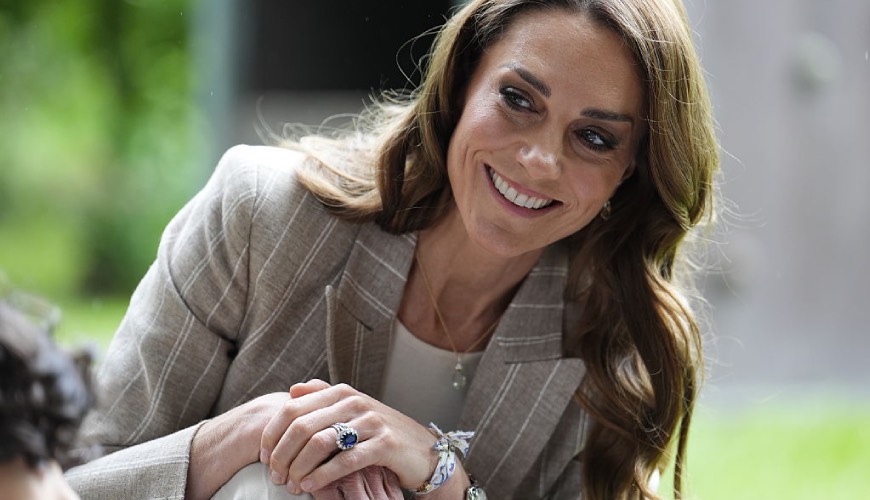
She’s wearing that sapphire and diamond engagement ring. You know the one. Diana famously wore in her engagement photos with Charles on the lawn of Buckingham Palace in 1981. She continued to wear it until her death in 1997. William gave it to Catherine on a hillside in Kenya in October 2010. Ever since then that ring has remained steadfastly on her finger. It is the longest continuously worn engagement ring in the modern royal family, and it has become the most recognisable single piece of jewellery in Britain. Every single photograph that Catherine has appeared in for the subsequent fifteen years, that ring has been there. It’s a constant presence in her life.
Catherine is one of the most photographed women in the world, and over fifteen years she has developed a particular taste in jewellery that royal watchers and the Maisons follow closely. State dinners in tiaras from the royal vault. School drop-offs in Robinson Pelham earrings. Van Cleef & Arpels suites. Cartier classics. Whatever she wears, she has chosen it deliberately. Here are the pieces that have defined the first fifteen years of her Royal life, and the life of a future Queen.
The engagement ring
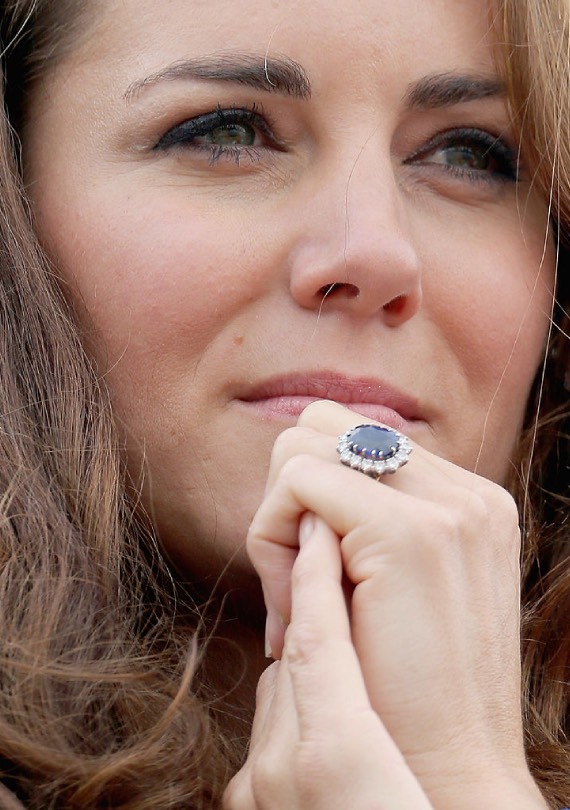
The engagement ring is one of the best known pieces of jewellery in the world, perhaps ever. At the heart of the ring sits eighteen carats of Ceylon sapphire, surrounded by fourteen solitaire diamonds, set in 18-karat white gold. It was designed by Garrard for Charles and Diana’s engagement in 1981, chosen by Diana herself from a tray brought to her at Buckingham Palace. It has been reported she picked it because it was the largest. After Diana’s death in 1997, the ring initially went to Prince Harry. He later swapped it with William so that William could give it to Catherine.
This is not an understated piece of jewellery, it’s a statement. The central sapphire is roughly the size of a peppercorn, and Catherine has worn it almost every single day for fifteen years. And that’s an interesting choice, to wear a ring that has so many historical connotations. The ring is not just an engagement ring. It consistently reminds us of the presence not only of Diana in William’s life but in Royal life.
The Cartier Halo Tiara
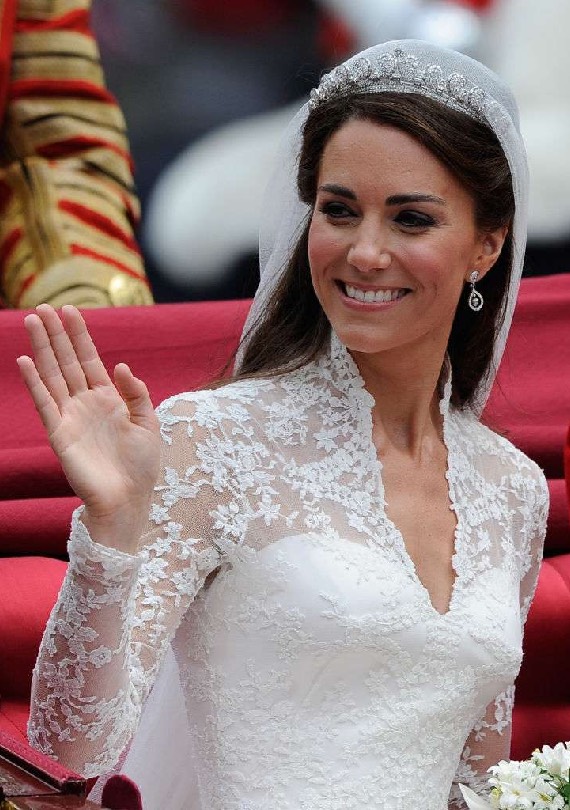
On her wedding day on 29 April 2011, Catherine wore the Cartier Halo Scroll Tiara, which was lent for the occasion by the late Queen Elizabeth II. The piece was made by Cartier in 1936 and bought by the Duke of York, who later became George VI as an anniversary gift for his wife Elizabeth, who became the Queen Mother. For her eighteenth birthday in 1944, the tiara was given to Princess Elizabeth. She later gifted it to Princess Margaret.
The choice was deliberate. The Queen Mother, whose tiara Catherine wore down the aisle of Westminster Abbey, had also married into the Royal family from outside. She was the daughter of an earl, and not a princess. A century apart, two women had walked into that family as commoners. The tiara drew a parallel across the years. The Halo has 739 brilliant-cut diamonds and sixteen baguette-cut diamonds. It is also, by tiara standards, almost restrained, a continuous band rather than a tower of stones. The choice was smart. It’s what William has leaned into ever since, a traditional but less ostentatious monarchy. A quiet Crown.
The Lover’s Knot

If that Cartier tiara defined her wedding day, the Cambridge Lover’s Knot Tiara has defined Catherine’s state event jewellery wardrobe ever since. It was made by Garrard for Queen Mary in 1914. It was a copy of a piece commissioned by her grandmother. The tiara comprises nineteen arches of diamonds, each topped with a swinging pearl drop. It belonged to Queen Mary, was inherited by Queen Elizabeth, but “owned” by Princess Diana.
Catherine first wore it to the annual Diplomatic Corps Reception at Buckingham Palace in December 2015. She has worn it more than two dozen times since. The Lover’s Knot, like the engagement ring is the piece of jewellery most associated with Diana. By wearing it Catherine is not only her successor, but she is also now the most photographed woman in world fashion and jewellery. There is movement on the pearls. They’ve been moving on Royal heads for over a century.
The Bahrain Pearl Drop earrings

Since Queen Elizabeth’s death Princess Catherine has inherited much of her jewellery. And the Bahrain Pearl Drop earrings are one of the most significant pieces of the Royal jewellery collection. They were made for Queen Elizabeth II from pearls given to her as a wedding present in 1947 by the ruler of Bahrain. In the second half of her reign they were one of the pieces she wore most often.
Since the Queen’s death in 2022, Catherine has worn the earrings repeatedly. At Easter Sunday services, at the enthronement of the Archbishop of Canterbury, at moments where the symbolism of inheritance is the point. They are, in jewellery terms, quite plain. It’s a simple pearl drop, and a single brilliant-cut diamond at the top. But what they signify is more important. They are the single most direct piece of jewellery handover from the late Queen to the future Queen. Catherine fully understands historical significance and symbolism. And she wears them as such. A power statement.
The Van Cleef & Arpels Alhambra suite

For easy wearing, day to day, it’s Catherine’s Alhambra suite. Her mother-of-pearl Alhambra necklace, bracelet and earrings are thought to have been a gift from her royal in-laws, and have appeared at concerts, school events, family Christmas portraits, low-key public engagements across more than a decade. The Alhambra line was introduced by Van Cleef & Arpels in 1968 and was famously worn by Princess Grace of Monaco. The design is based upon a quatrefoil motif inspired by the Moorish architecture of Spain’s Alhambra Palace in Granada.
Why it’s significant is because it’s not a British royal heritage piece. It’s European, mid-century, fashion forward, rather than dynastic. See our piece on the Alhambra here. By wearing the Alhambra motif Catherine is aligning with one of the most recognisable jewellery codes in modern luxury, and also gently reminding us that the future Queen’s wardrobe is not simply about inherited British vault pieces. She is a woman who wears and understand contemporary jewellery, and she knows exactly how to wear it.
Robinson Pelham
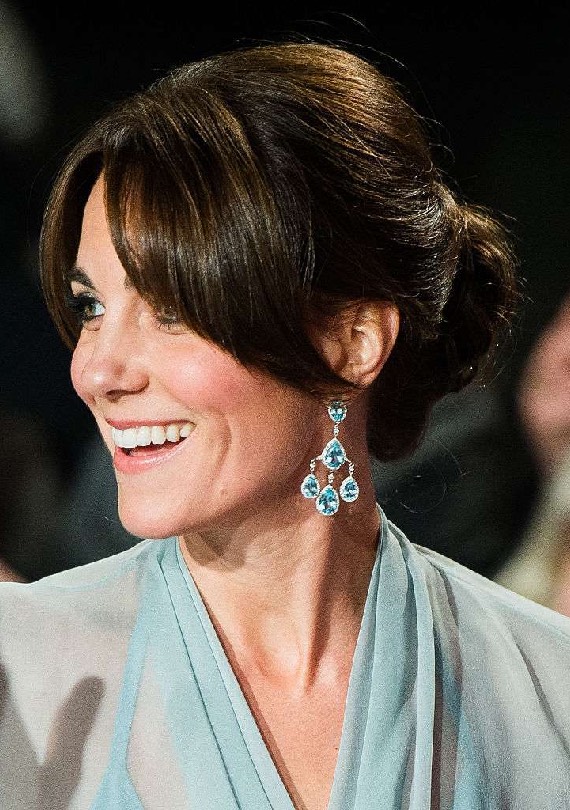
If there is a designer Catherine has done most for commercially over fifteen years, it is the British house Robinson Pelham. The diamond, blue topaz and white gold Pagoda earrings she wore to the world premiere of Spectre at the Royal Albert Hall in October 2015 were borrowed from her mother, Carole Middleton. Another reminder that Catherine moves between two jewellery wardrobes, the royal vault and her own family’s, and treats them equally at ease.
Robinson Pelham have also designed earrings worn by her sister Pippa Middleton at her own wedding, and by Princess Charlotte at her christening. The relationship between the Middleton family and the house has become one of the clearest examples in modern royal jewellery of a future Queen using her wardrobe deliberately to support a single British designer. It is small production, contemporary, British, and her choice.
The Nizam of Hyderabad necklace
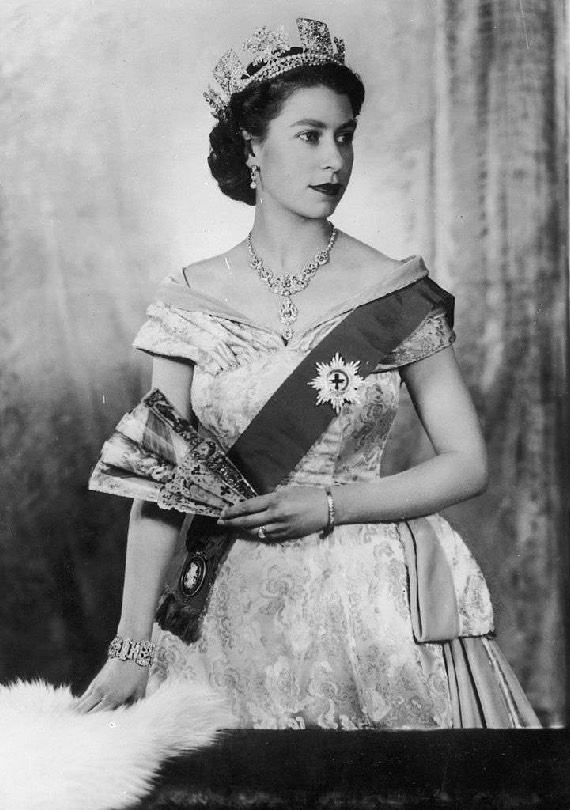
For special occasions, the vault. The Nizam of Hyderabad necklace was made by Cartier in 1935 and given to the late Queen Elizabeth II as a wedding gift in 1947 by the last Nizam of Hyderabad. It was the Queen’s most-worn diamond necklace across her seventy-year reign. In 2014, she lent it to Catherine for a black-tie reception at the National Portrait Gallery, where Catherine paired it with a midnight-blue Jenny Packham gown. It is estimated to be worth around £66 million, making it the most valuable single piece in the royal collection.
The Nizam necklace is the kind of piece that signals the wearer has access to the top tier of the royal jewellery vault. Catherine has had access to the rarest pieces in the collection across fifteen years — the Lotus Flower Tiara, Diana’s emerald and diamond collar, the Greville Chandelier earrings. But the Nizam appearance is another level. In hindsight it was a message from the late Queen where it became clear how much trust Queen Elizabeth placed in her.
Atelier Molayem bracelet
For her first overseas tour since her cancer diagnosis, the Princess of Wales chose a bracelet that wasn’t about jewels at all. The piece on her wrist in Reggio Emilia was by Atelier Molayem, a small Italian artisan jeweller. It carried the initials of her three children, George, Charlotte and Louis in 9kt yellow gold cubes set on an original Liberty fabric. It was a gift from a friend, the designer told People magazine. She and the jeweller had no idea that Catherine would wear it. The result for the jeweller was so huge that their site crashed.
Wearing the bracelet conveyed a double message. Firstly, it was a diplomatic gesture. She was wearing an Italian brand in Italy, a quiet thank you to the country she was visiting. Secondly there was a personal tribute. A mother on her first major trip away from home since her illness, her three children’s initials worn on the wrist isn’t just subtle symbolism.
Her jewellery, fifteen years later
What is striking, looking at the full fifteen years together, is how consistent Catherine’s jewellery choices have been from the start. There is no abrupt shift in style, no period of experimentation which now looks out of place. there’s been no misstep. It’s all elegant and a journey of the everyday wearable to the most significant state pieces. The pieces from her entry in Royal life back in 2010, the engagement ring, and the Halo on her wedding day, through to contemporary pieces for the school run is still what she uses to this day.
What has expanded is the depth. Where in 2011 Catherine wore borrowed pieces to almost every formal occasion, in 2026 she wears pieces from the royal vault that have been quietly transferred to her own collection, gifts received in her own right, and her own selections from contemporary designers. The next fifteen years, almost certainly bringing a coronation, more state visits, and the anticipated change from Princess of Wales to Queen will see her jewellery collection continue to develop. But she’s stayed true to her style and there’s not a piece that looks wrong.
The next generation will be watching closely, while the sapphire ring will remain on her hand throughout.
Click here for the latest watch and jewellery news straight in your inbox.