
The Girls of Great Britain and Ireland Tiara
It feels fitting to begin any countdown of the Queen’s most lavish tiaras with one of her very favourites: The Girls of Great Britain and Ireland Tiara.
This tiara takes its name from a committee of women, led by Lady Eva Greville, who raised money for its creation and purchased it from Garrard, in June 1893. The headpiece is made of diamonds set in silver and gold, and features classic fleur-de-lis and festoon motifs. It can also be taken off its frame and worn as a necklace. The original design, which was created for Princess Mary of Teck on the occasion of her marriage to Britain’s Prince George, Duke of York, was additionally topped by fourteen large white pearls, giving it extra height.

When Mary’s husband George ascended the throne in 1910, the newly-minted Queen Mary chose to wear the tiara for one of her first official portraits. Four years later, Queen Mary removed the large pearls from the top of the diadem, and replaced them with 13 diamond brilliants (the pearls were incorporated into the Lover’s Knot Tiara, which has been worn by Princess Diana and HRH The Duchess of Cambridge).

When the-then Princess Elizabeth married Prince Philip in 1947, her grandmother, Queen Mary, presented her with the tiara as a wedding gift and it quickly became one of her favourite jewels – though she still fondly referred to it as ‘Granny’s tiara’. Later, after she was crowned, the Girls of Great Britain and Ireland tiara became one of The Queen’s most recognisable jewels, as she frequently wore it to important state occasions.
Queen Mary’s Fringe Tiara

Queen Mary commissioned this shimmering , kokoshnik-style diadem from the Garrard in 1919, using diamonds that were part of a necklace that she received from Queen Victoria as a wedding gift in 1893. Ever the jewellery innovator, Mary had the gems removed and transformed into this Russian-style fringe, which were very fashionable during the time of the Romanovs.
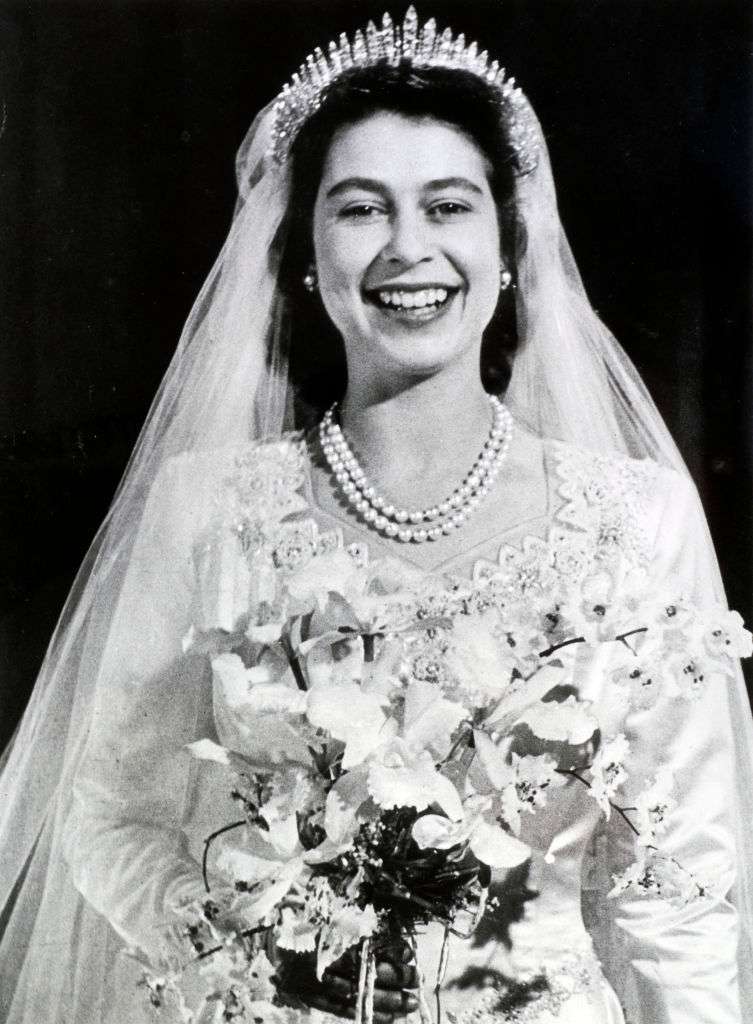
In 1936, Queen Mary gave the tiara to her daughter-in-law, Queen Elizabeth (formerly Elizabeth Bowes-Lyon), who then lent the tiara to her own daughter, Princess Elizabeth, as her ‘something borrowed’ for her royal wedding to Prince Philip in 1947.
The headpiece features 47 bars of diamonds, one of which famously snapped as the tiara was placed on the bride’s head. And though the break was quickly mended by a Garrard jeweller before the Princess left for Westminster Abbey, a small space is still visible between two of the tiara’s central spikes in close-up photos of the beaming bride.
The Vladimir Tiara

The Vladimir is an historic tiara with a fascinating back story. It once belonged to the glamorous Grand Duchess Vladimir, wife of the Tsar’s uncle, the Grand Duke Vladimir Alexandrovich of Russia, who was a famous jewellery lover and collector. She was the last of the Romanov family to escape Russia during the Revolution of 1917.
The tiara was created for the Duchess by Russian court jewellers, Bolin, and was one of 224 her jewels smuggled out of Russia by the British antiques and art dealer, Albert Stopford.

After the Duchess’s death in 1920, many of her jewels, including this tiara, were sold off to support her children. Queen Mary, grandmother of Queen Elizabeth II, bought the Vladimir Tiara and had it repaired at Garrard. She also added a clever mechanism which allowed the large central pearl drops to be easily exchanged for 15 spectacular emerald drops, said to have once belonged to the Duchess of Cambridge, the daughter-in-law of King George III.
The tiara was eventually passed from Mary to her granddaughter, Queen Elizabeth, who wore it often throughout her reign, including for an official portrait by Sir William Oliphant Hutchison in 1956.
The Nizam of Hyderabad Tiara

Alas, this is one of the Queen’s tiaras that no longer exists.
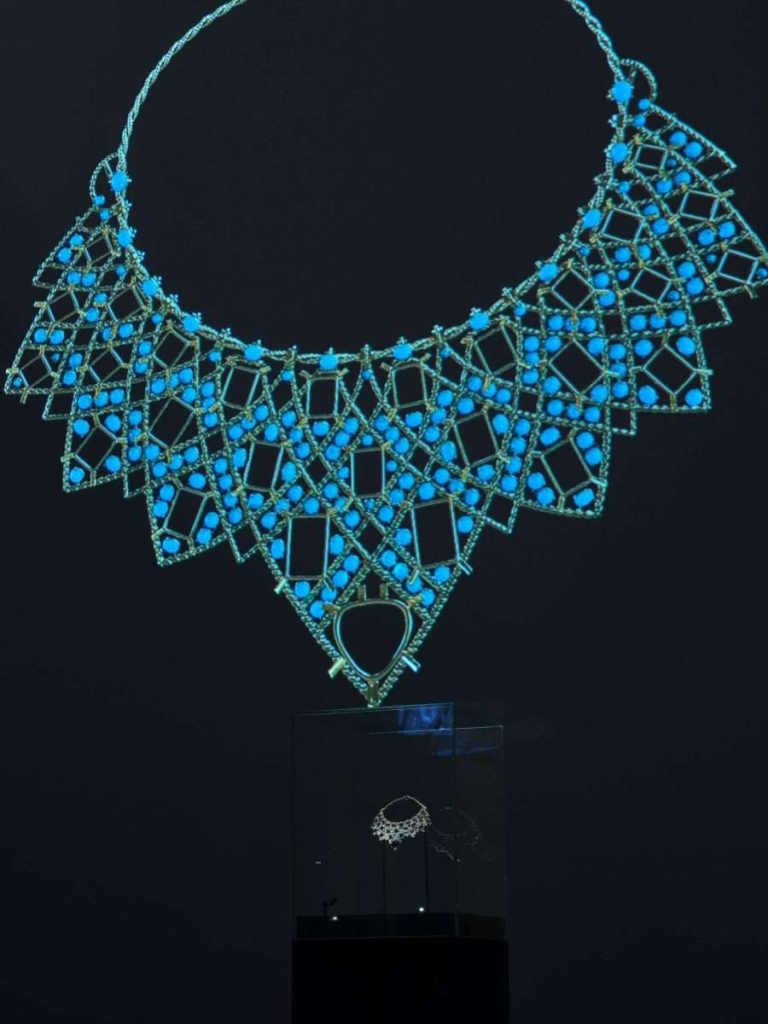
Princess Elizabeth received this elegant tiara in 1947 as part of a jewellery suite gifted to her by Asaf Jah VII, the Nizam of Hyderabad, to celebrate her wedding. The wealthy Nizam left instructions with Cartier for the Princess to choose anything from their stock as part of her present, and she chose the diamond and platinum floral set which included the tiara (which included detachable motifs that could be worn as brooches) and a matching necklace. Both pieces actually dated back to 1935, and could be worn separately or together.
In 1973, the Queen sadly dismantled the Hyderabad tiara. She removed its diamonds and instructed Garrard to combine them with a collection of blood-red Burmese rubies to create the Burmese Ruby tiara, which was one of only two major ruby headpieces she was photographed wearing during her reign. The new diadem featured the rubies set in heraldic rose motifs.

King George IV’s Regal Circlet

One of the most iconic of all the Queen’s tiaras, this regal Circlet of gleaming roses, thistles and shamrocks (plants which are emblematic of the United Kingdom of Great Britain and Ireland) was actually created for a king.
The silver and gold-lined headpiece was ordered from Rundells in 1820 for King George IV, and was created with rows of gleaming white pearls and 1,333 diamonds, including a four-carat pale yellow brilliant. The King wore the headpiece at his coronation in July 1821 over a large velvet hat.
Since then, the circlet has only ever been worn by queens regnant and consort – never again by a king. Queen Elizabeth first wore the sparkling diamond piece to her first State Opening of Parliament in 1952, combined with a pearl and diamond necklace given to Queen Victoria at the Jubilee in 19987. She subsequently wore it to all State Openings, and for official photographs including those used for coins, banknotes and postage stamps – making it one of the most widely recognised diadems in the world today.
The Imperial State Crown

Made for the coronation of the late Queen’s father, King George VI, in 1937 by Garrard, the Imperial State Crown is perhaps the most significant topper in the royal collection.
Featuring almost 3,000 diamonds and 269 pearls, 17 sapphires and 11 emeralds, Her Majesty wore the crown on many occasions during her 70-year reign, including at the annual State Opening of Parliament.
Like this? Discover more momentous jewels from the Queen’s collection