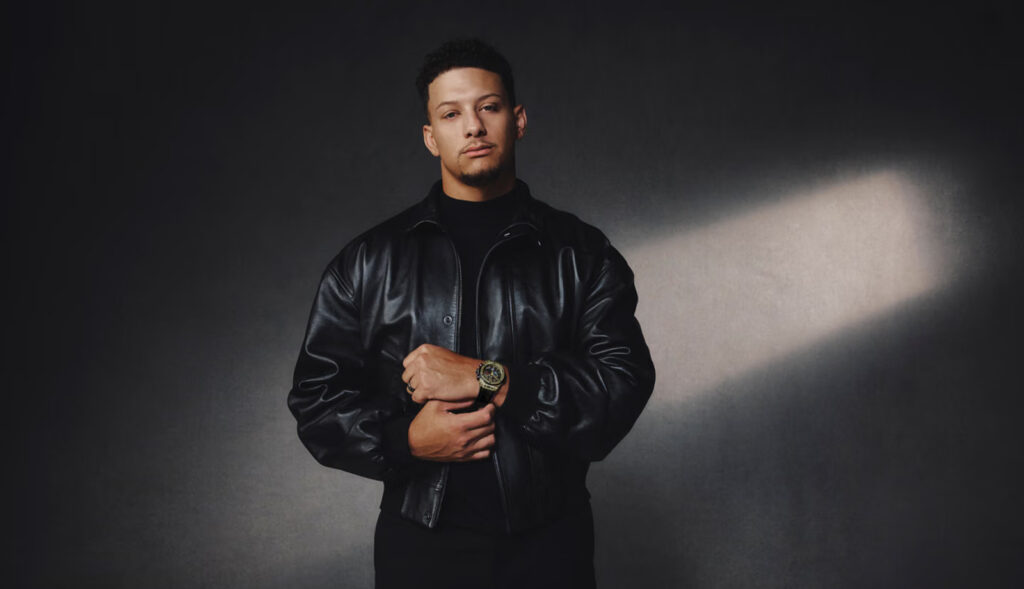
Quietly heralding change is jeweller MJ Jones, who moved from customising watches to creating trophy rings for sports stars, applying watch world technology rather than traditional jewellery-making techniques.
Trophy rings, a jewellery trend imported from America, are worn by sports stars from the NFL and NBA, who commission them after winning a trophy. They can’t take the trophy home, so they celebrate their success with a ring. Matthew Jones, who was raised in the Midlands in a football family – his father was a former player who became assistant manager for teams like QPR and Crystal Palace – understood the concept and saw an opportunity.

“I was always obsessed with fashion and luxury brands and bought my first watch, a Breitling Navitimer, when I was 21,” he recalls. He was introduced to a watch retailer who offered him luxury watches to sell to the network of footballers, celebrities and business leaders that Jones reached out to. Gradually, he expanded his concierge service, offering various customised finishes to the models. “Learning about this technology, I could see how we could apply it to make our fine jewellery, like the DNA rings and Spiked collection,” he explains. The method is completely different to traditional bench jewellery making as it uses CNC (computer numerical control) a costly but widely used process in the making of watches, to construct the jewellery item and to create the signature details like his ‘cage’ monogram on the DNA rings, as well as DLC (diamond light carbon) for a matt black finish for the gold dog tags.

Using CNC, Jones and his business partner Tommy Anastasiades started making bespoke gem-set trophy rings, that feature a 3D model of the winner’s trophy beneath sapphire glass, commissioned by a formidably talented clientele that includes Lionel Messi, Luis Suarez, Marcus Rashford, top Swiss footballer Alisha Lehmann, cricketers, rugby players and the Lionesses. “A lot of the styling you see in winners’ rings come from watchmaking,” he explains. “The product is more precise: it’s part machine and part handmade and I think it’s the future of fine jewellery.”
In 10 years, MJ Jones has built a client list of between 5,000 and 6,000. He will be opening the ‘Pyramid’ in early spring, a retail and experiential location in London that is shaped like a pyramid, which they serendipitously located after designing their newest Pyramid collection. There are plans for a flagship in Europe servicing his sports clientele there and then in America. Jones has found his niche as the go-to brand for impactful jewellery to reward success: “When it comes to winning, they come to us to celebrate, it is the DNA of our brand.”

Another non-conformist successfully navigating the luxury world is Hannah Martin. When establishing her business in 2006, the problem for the cult jeweller was that the retailers didn’t quite know where to place her. Dover Street Market was the first to understand that her masculine rock ‘n’ roll-style jewellery appealed across genders.
“The idea of gender is critical to my work,” explains Martin. “I wrote my thesis on masculinity and called it Shades of Gender, and that was back in 2004 when the words gender-fluid didn’t exist. I never liked the words androgynous or unisex. However, it has been amazing to see that change. It’s the biggest I’ve seen in the industry since I began,” she adds.
Martin has played her part in the evolution of jewellery for men by producing highly refined gold pieces inspired by the seditious energy of punk. Her recent HMp collection, for example, is a provocative range of sculptural designs for piercings. A large part of her business is creating tour jewellery for bands. “A lot of clients are musicians and creatives. I guess what I do is fairly alternative, and I try to capture in my jewellery the essence of whatever makes a musician get on stage,” she says.
Born in Yorkshire to a mining family, Martin was raised in Bristol by parents who were heavily into music. “Jewellery wasn’t in my orbit; I didn’t know designing jewellery was a thing until I did a foundation art course and spent a week making jewellery and loved it,” she says.

At London’s Central Saint Martins, a tutor encouraged her to combine jewellery with her passion for music. “Music is in my DNA, going to gigs every week has always been part of my life.”
However, this didn’t prevent her from failing to recognise the man standing in front of her in a queue at Heathrow airport after a flight from Los Angeles. “I spotted a person wearing a gold and sapphire hoop earring, one of the first pieces I had made, and realised that I had to say something. We got talking and back in the studio the next day he messaged me on Instagram. My team were like, ‘Wait a second, he’s got over 300,000 followers, who is he?’ so we Googled him, and I thought ‘Oh shit, he’s from Coldplay’.” In fact, it was the bassist, Guy Berryman.
Berryman, having studied architecture and engineering before forming Coldplay, started a design studio in 2020 called Applied Art Forms producing a line of unisex clothing inspired by vintage workwear and uniforms. “It was an amazingly serendipitous moment as he had been having thoughts about expanding into jewellery and didn’t know where to start and it was like the universe drawing us together,” says Martin.
Chatting with Martin, who is unforgettable with her black mohawk and an ear full of gold screws, nuts and bolts, Berryman spotted an opportunity in this like-minded spirit and over the ensuing months they discussed shared interests in punk and industrial design. Their recently launched A Vanitas collaboration includes gold and silver razor blade earrings, dog tag pendants and hefty rings, hospital band bangles and skull earrings. “It was a very easy, democratic and pleasurable process,” enthuses Martin, “and we are already talking about doing more.”

Musicians are similarly drawn to Chiefer Appiah’s jewellery, his clientele is largely from the hip-hop scene and boxing world with Anthony Joshua, David Adeleye and Derek Chisora alongside rappers like Nines, Skrapz and soul singer Jorja Smith making the journey to Berkeley Street for his luxury diamond-smothered watches and jewellery. They trust him as “I can translate what they are asking for because I understand their lifestyle,” says Appiah.
Chiefer is the first black jeweller to have a street-level premises in Mayfair “and I’m so happy at the welcome response from my neighbours,” he says. “I’ve been met by a lot of resistance in my career, but times are changing. Rolls Royce, offered their showroom for my launch party which would have been unheard of before.”
Raised on an estate in Tottenham, he is of Ghanaian descent where gold jewellery is prevalent in the culture: “My mother is heavily into it and had a big jewellery box that I fell in love with.” When he was 15, Appiah and a friend designed some chunky chains and found a jeweller to make them. “Wearing them around my estate, friends started asking for them and I thought I could add a little commission and sell them, but I didn’t take it seriously.”

For a while, he got into music management with his cousin Sway, a rapper, but when he lost the sight in one eye due to sickle cell disease, he turned to jewellery gaining his knowledge commissioning bespoke pieces around the jewellery quarter in Hatton Garden for his music industry clients.
That was 12 years ago, and he’s gradually established a reputation as the Bussdown King – a customising process whereby every millimetre of metal on watches, pendants, chains and rings is covered with diamonds.
“It is rooted in American street culture and the hip-hop scene, and now you see luxury watch brands really close-setting diamonds.” He is working now on new collections and expects them to be covered in diamonds.
Like this? Watch cover star Amelia Gething as she talks Mary & George, fame and YouTube
Sign up to our newsletter to get exclusive access to the latest jewellery news