
Louis-François Cartier was just twenty eight years old when he founded one of the world’s foremost jewellery houses, Cartier, in 1847 at 29 Rue Montorgueil in Paris.
Nearly thirty years later in 1874, his son Alfred took control of the company and he soon had an array of clients flocking to the maison to buy Cartier designs. However it was Alfred’s three sons, Louis, Pierre and Jacques, who would go on to take the Cartier name all around the world and establish the Cartier house as synonymous with world famous jewellery.
Louis stayed in Paris while Jacques headed to London in 1902, shortly after receiving a Royal Warrant and supplying jewellery to King Edward VII and his court. Pierre, meanwhile, headed to New York and in 1917 acquired 653 Fifth Avenue. This address remains Cartier’s New York flagship store today.
Such forward thinking on the brothers parts meant the brand would quickly become a favourite with royalty and film stars, as well as business tycoons. Elizabeth Taylor, Grace Kelly, Clark Gable and the Duchess of Windsor are a handful of the notable names who have had jewellery made or went to Cartier to buy a special piece.

Aside from notable clients, Cartier has some incredible creations and certain design classics that are instantly recognised as uniquely Cartier.
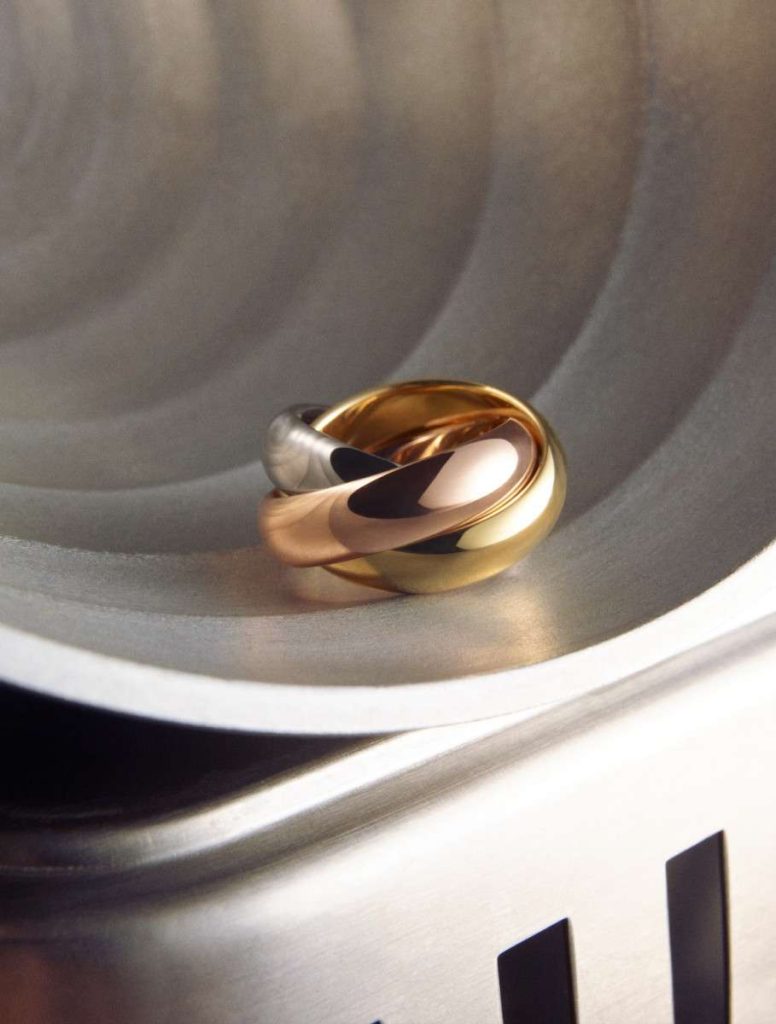
Important pieces include the famous Trinity ring which celebrated its 100th anniversary this week in Paris. The three-ring debuted almost a century ago in 1924 during the heyday of Art Deco. Designed by Louis Cartier at the request of Jean Cocteau, the three interlocking rings are spun of different golds – white, yellow and rose – symbolising friendship, fidelity and love.
The popularity of the Trinity collection grew in the 1950s and 1960s when celebrities including Alain Delon, Romy Schneider, and Grace Kelly were spotted wearing the ring. The beauty of the Trinity was its simplicity and signified that Cartier designs were for a wide array of customers. This allowed the brand to become accessible and renowned not only for high jewellery designs. Its iconic design codes made its way into an array of Cartier products. Today, the Trinity ring is recognised as an icon in the world of fine jewellery and a testament to Cartier’s rich history as well as its innovation.

For the centenary a new version of the Trinity has been created. The bands have been reshaped and distorted into cushion shaped ‘squared’ links. This first chapter included classic and large models of the ring both in simple gold or adorned with dazzling diamonds, alongside a matching bracelet and pendant. Cartier has also reintroduced the Maximalist Trinity bracelet and increased the volume of all three bands into an extra large piece.

The Cartier Panther is another classic design and of course synonymous with the Maison and a constantly reoccurring theme of its creations. The “Great Cat” motif appeared in 1914 as an onyx-spotted panther pattern wristwatch created by the famous French designer Charles Jacqueau.
The initial pattern has evolved to fully sculptured animals, and the array of cats has broadened: to include the striped tiger as well as the panther. It was Jeanne Toussaint, who was known to be a fan of felines, who was nicknamed “The Panther” by Louis Cartier, who became responsible for supervising the cat designs. Along with Peter Lemarchand, she created a variety of jewels which would forever immortalise the feline motif and make it synonymous with Cartier.
Through a century of design, the Cartier cats have gone through various iterations but are still much in demand by jewellery collectors, with designs from the 1980s and 1990s increasing demand.

Another noted style is Tutti Frutti which was recently spotted on Hollywood superstar Timothée Chalamet. In the early years of the last century Cartier acquired Indian rubies, sapphires and emeralds, carved with floral motifs and these were worked these into a new style of multi-gem jewels which were in contrast to the graphic Art Deco styles that were popular in the time.

The Love and Juste un Clou bracelets are the legacy of Aldo Cipullo, an Italian designer who joined Cartier in New York in 1969 and within two years he had created two icons of the house. The ‘Love’ bracelet, a band in two sections, has to be screwed together with a screwdriver, which is provided by Cartier. Once in a place, the bracelet cannot easily be removed. Cartier made the decision to gift his and her love bracelets to the most famous couples of the era, which included Elizabeth Taylor and Richard Burton as well as Steve McQueen and Ali McGraw.

Meanwhile, another name to note was Maurice Couët, a young clockmaker at Cartier who had been inspired by the magic clocks of illusionist Jean Eugene Robert-Houdin. Couët managed his very own take on these but via a more traditional clock-making route. In 1913, the “Mystery clock” made its debut. What it actually meant was that the hands seemed as though they were floating and no mechanism could be seen, all of which made the clock seem like magic – a trick that stunned staff and clients all at once.
Today, there are arguably a multitude of designs that are instantly recognisable as Cartier: Tank, Trinity, Juste un Clou, Santos de Cartier, Love, Panthère or Ballon Bleu, all of which are based on four main principles of the Maison’s creation. These are the purity of the line, the accuracy of the shape, the precision of proportions, precious details.

The maison has also received various royal seals of approval. King Edward VII of England used to refer to Cartier as “the jeweller of Kings and the King of jewellers”. It should come as no surprise then that at the coronation of King George V in June 1911, reportedly 19 of the tiaras worn at the ceremony were by Cartier. In fact, it would be from Spain to England and beyond – Belgium, Russia, India – that Kings and Queens around the world would also make Cartier their official supplier of royal jewellery. As did movie stars and society names of the time, such as Grace Kelly and Elizabeth Taylor.
The Duke of Windsor, at the time Prince of Wales, would also become a client, proposing to Wallis Simpson with a 19.77-carat emerald ring made by Cartier in 1936. He further bought a flamingo brooch in 1940 and a Panthere brooch in 1949 – it featured a 152.35-carat cabochon sapphire.

King George VI also bought various pieces for his wife, the Queen Mother. And she also inherited some significant pieces from Dame Margaret Greville, notably the Greville Chandelier earrings, platinum and fancy-cut, which were later given to Queen Elizabeth II as a wedding present in 1947. One of the most famous Cartier pieces owned by Her Majesty is the Halo tiara. It was a gift to her on her 18th birthday, having previously belonged to the Queen Mother. It was loaned to the Duchess of Cambridge for her wedding to Prince William in 2011.
Like this? Stéphane Bak models the new Cartier Le Voyage Recommencé high jewellery collection