Monica Vinader jewellery went on sale in selected Goldsmiths and Mappin & Webb stores today, marking the physical retail launch of its partnership with the Watches of Switzerland Group (WoS).
The brand is now available at Goldsmiths Meadowhall in Sheffield and through a dedicated Monica Vinader pop-up inside the Mappin & Webb jewellery showroom in Manchester. Its collections have been available through both retailers’ websites since 1 October.
At the centre of the partnership is the MV Siren collection, which features lab-grown diamods with a bespoke 64-facet cut. WoS describes the collection as being “available exclusively through the Watches of Switzerland Group as a watches and jewellery specialist retailer”. The collection is also available to buy direct from Monica Vinader.
WoS is also the exclusive watch and jewellery retail partner for Monica Vinader’s 14-carat gold jewellery collection, including its Shimmer, Mini Heart, Mini Paperclip and Beaded chain designs.
Craig Bolton, UK president of Watches of Switzerland Group, said the partnership would broaden the retailers’ appeal among existing and new customers while increasing the “breadth and accessibility” of their jewellery assortment.
He added: “The brand brings a fresh and distinctive perspective to contemporary jewellery, combining modern design with craftsmanship and a strong sense of personal expression. We look forward to growing the brand across our retail and online channels and building on the continued momentum within this important category.”
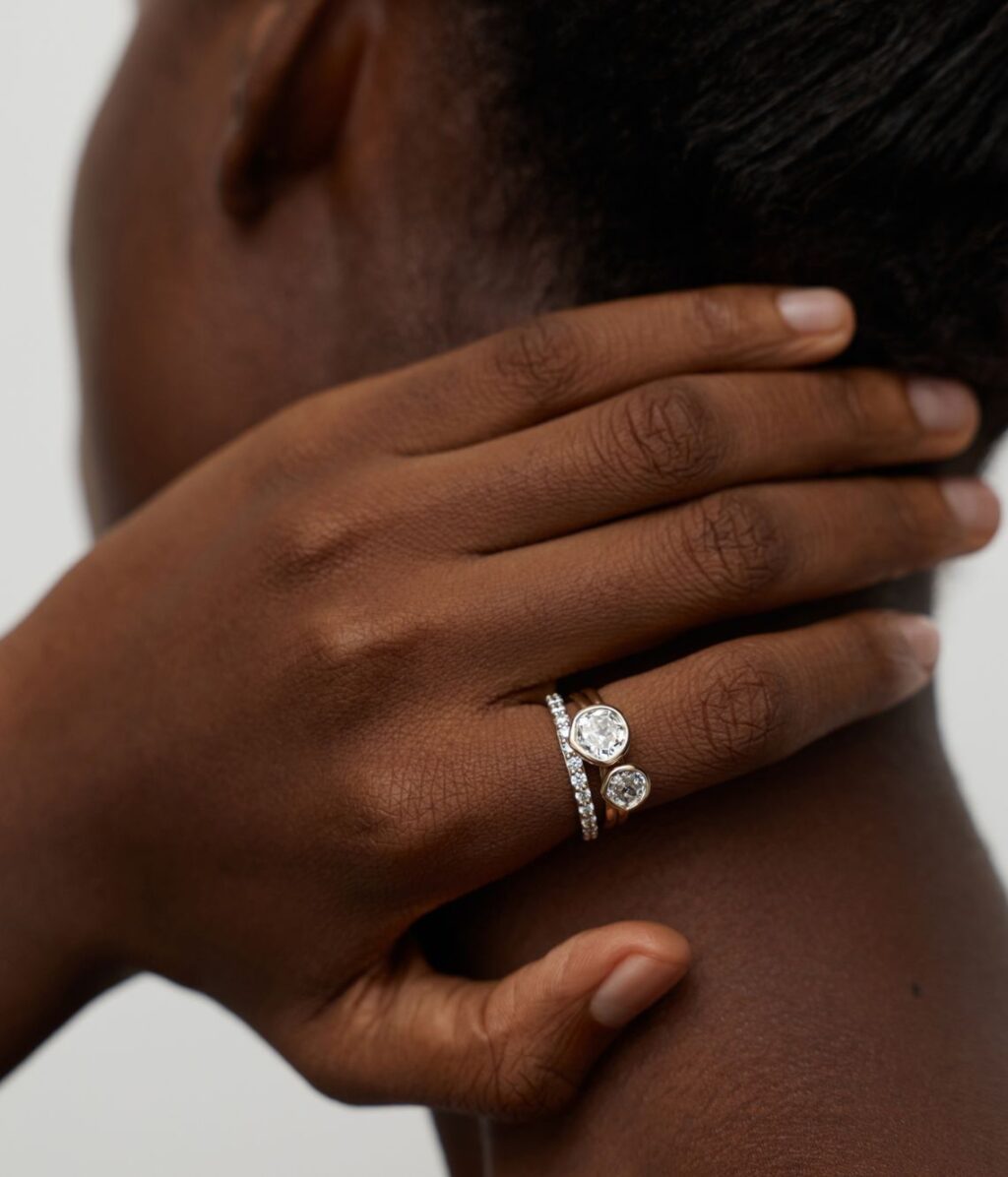
A stack of gold and lab-grown diamond rings by Monica Vinader. (Monica Vinader)
Jewellery remains a strategic growth category
The in-store Monica Vinader launch supports WoS’s wider effort to build jewellery as a larger and more diversified part of its business. Luxury jewellery revenue at WoS increased 18% at constant currency to £238 million in FY26, and in its latest trading update, covering the 17 weeks to 30 August, the group identified luxury jewellery as one of its “strategic growth pillars”.
Last year, WoS opened a 700sqm Mappin & Webb flagship in Manchester, using a new “house of brands” concept to bring established maisons and emerging designers together in a showroom dedicated exclusively to luxury jewellery.
It is continuing to seek out growth in jewellery and watches. In its latest trading update, WoS noted that it has has opened a multi-brand showroom in Avalon, Georgia, is converting the existing Mayors store there into a dedicated luxury jewellery location, and plans to open Watches of Switzerland and Mayors showrooms in Marlton, New Jersey, and reopen Betteridge Greenwich, Connecticut, before Christmas.
In the UK, the group has reopened its Goldsmiths showrooms in Chelmsford and Watford following refurbishment and expansion, with its planned Glasgow Rolex store also scheduled to open before Christmas.
New York-based fine jewellery designer Tara Maria Famiglietti has had an illustrious career spanning more than two decades. First recognised in 2002 by New York Magazine as a ‘Designer to Watch’, she has since won Couture Design Awards for her brand Ondyn in 2021, 2023 and 2024, and was nominated again in 2026 for her line of articulated diamonds.
Here, she speaks about the growth potential in fine jewellery, the importance of pricing stability and retail partnerships, and why originality will define the industry’s strongest brands.
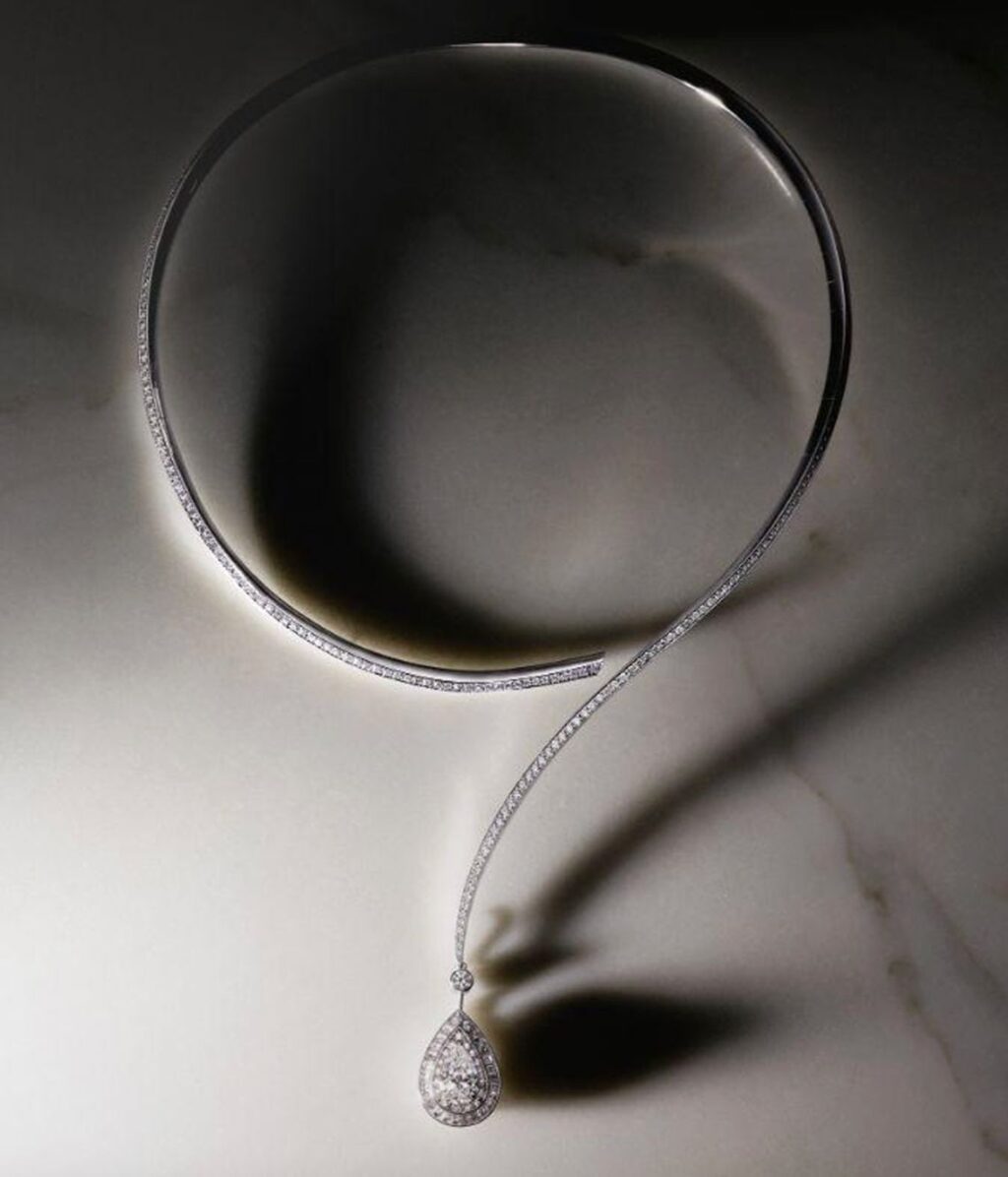
Diamond Bias necklace and Grand Fringe cuff by Ondyn (Ondyn)
In conversation with Tara Maria Famiglietti
As the jewellery market becomes more global, competitive and consolidated, what does a luxury brand need to offer? “You cannot rely on beautiful product alone anymore. Clients have access to everything, so a luxury brand has to make people see something in a new way. It is about creating curiosity, telling a story and presenting ideas that feel unexpected. For an independent brand, that is a real advantage: you have the freedom to think outside the box.”
Where do you see the greatest growth opportunity for jewellers in the next three to five years? “Fine jewellery has the greatest opportunity. Women are buying it for themselves, buying it for their daughters, wearing it every day and collecting it over time. High jewellery will always help define a brand, but fine jewellery is where clients build lasting relationships.”
How do you grow without compromising the creativity and exclusivity of a brand? “I always say that I want to evolve the language, not repeat the sentence. A brand needs recognisable signatures, but it also needs to keep surprising people. I have never designed with a particular age in mind, either. My work has always been a little progressive, whether it resonates with someone who is 25 or 75. Communication evolves, but the product should never be compromised and watered down to appeal to a demographic.”
Tara Maria Famiglietti picks up Ondyn’s award for Best in Diamonds Below $40K at the Couture Design Awards 2024 (Ondyn)
How are current economic conditions shaping the way clients think about value, rarity and price? “Shoppers are definitely more selective. They think harder before they buy, but when something truly strikes a chord and feels exceptional, you have a sale. The appetite for luxury hasn’t dissipated, but I think the tolerance for ordinary luxury has. It feels like there’s been a bit of a reckoning.”
How does Ondyn balance rising industry costs from gold and labour with its commitment to stable pricing and design quality? “We look at each piece individually. The industry has faced enormous cost pressures, from gold prices and tariffs to manufacturing, but I never want to compromise a design’s integrity. We are also disciplined about pricing. Last year, we promised our retailers there would be no price increases for the entire year, and we plan to do the same this year. Changing prices is disruptive for us and for retailers. If we can offer stability in such a volatile industry, that is a meaningful way to build long-term trust.”
What role do retail partnerships play in Ondyn’s growth? “For Ondyn, retail partnerships are the priority. Luxury jewellery remains a personal purchase, and exceptional retailers create an experience that is difficult to replicate elsewhere. Our focus has never been on having the biggest footprint; it is on building long-term relationships with the right partners in the right markets.”
Ondyn Magic Bullet charm in gold and diamonds. (Ondyn)
Where do you draw inspiration beyond jewellery itself? “My creative well is mostly nourished by women – especially mature women with style, who know themselves and know what works for them. To me, that is part of the magic of being a woman, and it is very inspiring for design. I also find inspiration in vintage art photography, particularly Sam Haskins; antique stone busts; and my fragrance collection, which always puts me in a mood. My favourite right now is a Liquides Imaginaire called Blanche Bette. I love finding fragrances at Aedes Perfumery, a little jewel box of a shop on the Lower East Side in New York City, with its cabinet-of-curiosities display and beautiful floral décor.”
How do you approach the tension between jewellery that feels current and jewellery that lasts? “Both have their place. My personal style is jewellery that feels innovative yet eternal at the same time. Wearing only trend-driven pieces can feel thoughtless and, to me, lacking a point of view.”
Whose work has influenced your eye, across fashion, jewellery and design? “An all-time favourite is 1970s Saint Laurent. Among contemporary designers, I love the hat designer Maryam Keyhani. In jewellery, some of my favourites across the decades are Belperron, Hemmerle and Solange Azagury-Partridge. I also love the history, design, and traditional beauty of Ginori 1735 porcelain, as well as the work of artist Danielle Mckinney.”
Magic Wand bracelet by Ondyn, crafted in gold and diamonds. (Ondyn)
You divide your time between New York City, Sag Harbor, and rural Connecticut. How do those places – and travel – feed your creativity? “I love the contrast of Sag Harbor and Sherman, Connecticut, with living in NYC. Sag Harbor gives me the ocean, one of my great loves – vast and open. Sherman reminds me of the English countryside, cosy and quaint, with a simplicity I love. But some of my greatest creative inspiration comes from travelling to France and Italy. The way they preserve their cities and businesses, while continuing to support traditional craftsmanship and the arts, is something I deeply admire and respect.”
What will define the most successful jewellery businesses of the next decade? “Authenticity. Clients can compare almost anything today, and AI will only make that easier. The brands that stand out will offer something genuinely original – something that could not have come from an algorithm. Ironically, the more technology shapes our world, the more we will crave human connection. Whether it comes through a designer’s point of view, a story or the imagery surrounding a brand, people will be drawn to things that feel deeply considered rather than endlessly optimised. Our challenge as creatives is to step outside the algorithm and rediscover what truly fascinates us. That is where the next generation of meaningful brands will come from.”
If you had to name three principles for your personal manifesto, what would they be? “Create for a life beyond this moment. Absorb what moves me and transform it into something with relevance and meaning for years to come. Stay curious and malleable throughout life, so I can continue to evolve into the best version of myself. And always strive to be unique. Individuality is a superpower and the purest form of creativity.”
China’s tightening of tax rules around offshore trusts is creating a new demand risk for luxury jewellery and watch brands serving the country’s wealthiest consumers.
Rules introduced on 24 July treat the transfer of assets into an offshore trust as a disposal, with gains subject to individual income tax at 20%. Income generated by the trust can also be taxed annually at the same rate, including in some circumstances when it has not been distributed.
The measures apply retrospectively to certain assets and income from January 2023. A 90-day transitional period gives affected taxpayers until 22 October to declare historic liabilities and make payments without late penalties.
For luxury jewellery and watch businesses, the threat is significant. Clients facing large and unexpected tax bills might need to defer discretionary purchases. Others could become more cautious about highly visible spending as authorities increase their scrutiny of offshore wealth.
Hermes store in Beijing. (Henry Chen/Unsplash)
Luxury groups remain closely tied to China
China’s importance to the luxury sector extends beyond sales made in mainland boutiques. Chinese clients also support spending in international shopping destinations, while the country remains central to the growth strategies and retail networks of the largest European luxury groups.
Richemont offers the clearest indication of current jewellery and watch demand in Asia. Its Asia-Pacific sales rose 21% at constant exchange rates to €2.07 billion in the quarter ending 30 June, led by its jewellery brands, while sales across mainland China, Hong Kong and Macau increased by double digits. The picture was more subdued for its watch brands, for which Asia-Pacific sales were broadly stable, with a decline across China, Hong Kong and Macau offset by growth elsewhere in the region. Kering and LVMH have also reported growth in their jewellery and watch divisions and positive momentum in Asia, although neither publishes a precise regional revenue figure for those categories.
LVMH will publish third-quarter results on 12 October, followed by Kering on 22 October (the same day as the tax deadline), with Richemont publishing its half-year results on 13 November. While the results may capture an initial change in confidence following the July announcement, the figures will cover trading before the tax-payment deadline so will be unlikely to reveal the full impact.
Selfridges is currently hosting 13 jewellers at 40 Duke, the department store’s private members’ club and personal shopping destination in London, as part of a larger Frieze Week residency for the Sarabande Foundation.
The Sarabande residency forms part of a wider jewellery presence around Frieze Week, as brands and independent makers use of London’s art calendar to reach collectors. De Beers will present its natural diamond installation, Voyage Through the Diamond Realm, Chapter II: On the Birth of a Diamond, at Frieze Masters, while PAD London will bring together high jewellery exhibitors including Elie Top, Fernando Jorge, Hemmerle, Glenn Spiro and more.
The participating jewellers at the Sarabane pop-up at 40 Duke are Charlotte Garnett, Christopher Thompson Royds, Coline Assade, Conor Joseph, Emily Frances Barrett, Helena Palmeira, Jet McQuiston, Joy Bonfield, Kuniko Maeda, Mairi Millar, Matilde Mozzanega, Miya Kumo, and Shinta Nakajima. Each has been supported through Sarabande’s residency programme, either as a current artist-in-residence or alumnus. Established by the late fashion designer Lee Alexander McQueen, the charitable foundation supports emerging creatives with affordable studio space, scholarships, mentoring and opportunities to present and sell their work.
40 Duke gives the jewellers access to a highly engaged luxury audience in a setting designed around personal service and discovery. Access to the private shopping space is primarily offered to top-tier members of the Selfridges Unlocked loyalty programme, as well as customers attending personal-shopping appointments.
By combining access to private clients at 40 Duke with the visibility of a major cultural week in London, the residency gives Sarabande’s jewellers a platform to develop recognition and potential commercial relationships beyond the foundation’s own network.
Sarabande’s Selfridges residency continues in the main store with Sarabande’s House of Bandits pop-up, running from 5 to 18 October in the Duke Street Canopy. The space offers one-off and limited-edition works by Sarabande artists-in-residence and alumni, alongside live demonstrations.
The Frieze Week initiative builds on Sarabande’s existing relationship with Selfridges, following a House of Bandits pop-up on the lower ground floor of the London store from January to March last year.
Boucheron will open a public exhibition at Christie’s New York today, using its archives and latest high jewellery to build recognition as it expands its presence in the US.
Boucheron: In Focus – A Monograph of a Visionary runs at Christie’s Rockefeller Center from 9 to 18 October, tracing the Kering-owned maison’s development since it was founded by Frédéric Boucheron in Paris in 1858.
The exhibition brings together historic designs and pieces from Boucheron’s latest Carte Blanche high jewellery collection, which was launched in Paris this summer during Couture Week. The event will be the collection’s US debut. By presenting experimental new work alongside archival pieces, the format connects the maison’s contemporary offer with the creative history intended to distinguish it from better-established rivals in the market.
The choice of Christie’s auction house also places Boucheron in front of an existing audience of US jewellery, art and luxury collectors. While the exhibition is open to the public and is not positioned as a selling event, it gives the maison an opportunity to build awareness and introduce potential clients to its high jewellery outside a conventional boutique environment.
Boucheron’s Carte Blanche high jewellery collection, which launched in Paris in July and will make its US debut at Christie’s. (Boucheron)
Building recognition in the US
The exhibition arrives two years after Boucheron began a significant US retail expansion. It opened its first American boutique on Madison Avenue in September 2024, followed by a location at the Fontainebleau resort in Las Vegas that December. The maison has since expanded to Los Angeles.
Its arrival in New York was accompanied by an immersive public event presenting the Or Bleu high jewellery collection and its Quatre 5D Memory ring, establishing experiential marketing as part of its US launch strategy.
The Christie’s partnership moves that approach into a setting associated with connoisseurship and the secondary market. It also gives Boucheron a platform to showcase almost 170 years of design history to American consumers who may be less familiar with the maison than with brands such as Cartier, Tiffany & Co. or Van Cleef & Arpels.
Inside Cosmic Splendor: Jewelry from the Collections of Van Cleef & Arpels exhibition, held at the American Museum of Natural History in New York last year. (Van Cleef & Arpels)
Exhibitions as a luxury growth strategy
Large-scale exhibitions are becoming an increasingly important part of jewellery houses’ marketing strategies. Rather than focusing solely on existing clients, they allow brands to engage wider audiences through art, design, craftsmanship and cultural history, often without requiring visitors to enter a luxury boutique.
Tiffany & Co.’s 2024 Tiffany Wonder exhibition in Tokyo comprised nearly 300 objects, using immersive displays to introduce the house’s history and diamond heritage to the Japanese market. Cartier’s 2025 exhibition at London’s Victoria and Albert Museum assembled more than 350 jewels, watches and objects. Its subsequent Australian edition at the National Gallery of Victoria attracted 200,000 visitors, demonstrating the reach such projects can achieve beyond a brand’s established client base.
Bulgari has similarly used travelling Serpenti exhibitions to reinforce one of its most recognisable design codes in markets including Europe and Asia, while Van Cleef & Arpels presented more than 60 astronomy-inspired creations at New York’s American Museum of Natural History from April 2025 to January 2026 within the exhibition Cosmic Splendor: Jewelry from the Collections of Van Cleef & Arpels.
De Beers will take a similar approach at Frieze Masters in London next week, presenting an installation exploring the geological formation of diamonds titled Voyage Through the Diamond Realm, Chapter II: On the Birth of a Diamond, which will include displays of rough fluorescent stones next to arts and crafts from Botswana, where its diamonds are mined.
These projects allow brands to behave more like cultural institutions, using their archives as commercial assets and positioning signature designs as part of a broader design history. They also generate editorial coverage, social content and public engagement on a scale that private high jewellery presentations cannot.
For Boucheron, the Christie’s exhibition has an additional task: translating heritage into recognition in a comparatively new market. Its commercial value will not be measured solely through attendance, but by whether visitors continue the relationship at the maison’s growing network of US boutiques.
London-based jeweller Queensmith has noted increased client interest in unconventional diamond cuts and warmer colours as couples seek engagement rings that feel more individual.
The jeweller has identified old mine, moval, criss-cut, trapezoid and elongated hexagonal diamonds among the shapes attracting attention, alongside warm and coloured stones.
Laura Suttie, gemmologist and design expert at Queensmith, said antique-style diamonds had risen particularly strongly in popularity following the attention generated by Taylor Swift’s engagement ring. Old mine cuts date largely from the 18th and 19th centuries and were shaped by hand. Their individual proportions, chunkier facets and softer brilliance appeal to clients seeking character rather than the uniform appearance associated with modern brilliant cuts.
Queensmith is also seeing growing interest in movals, a hybrid of marquise and oval shapes. The cut retains the elongated appearance that has made oval diamonds commercially successful while offering a less familiar silhouette. Elongated hexagonal diamonds have also risen in popularity.
Criss-cut diamonds provide another variation on an established category. Developed by cutter Christopher Slowinski in New York during the 1990s, their intersecting facets introduce more light and movement into the clean geometry of a traditional step cut.
The jeweller said some clients are also embracing diamonds with visible yellow, brown or champagne tones. These warmer stones can offer greater individuality as well as a lower price than equivalent diamonds in the colourless grades, making their appeal both aesthetic and financial.
Cuts previously used principally as supporting stones are also moving towards the centre of designs, according to Suttie. Trapezoid diamonds can create the impression of greater overall size, either as centre stones or by visually extending a central diamond when used as a matched pair. This allows clients to add impact without paying to increase the carat weight of the principal stone substantially.
Japanese jewellery emerged as one of the most visible creative forces surrounding Paris Fashion Week this season, with brands participating at the Week’s various trade shows and a dedicated exhibition at Sotheby’s.
What united many of the brands was a strong sense of materiality and craft. At a time when international buyers are looking for designs that can distinguish their assortments, this combination gave the Japanese jewellers in Paris an immediately legible point of difference.
At Sotheby’s Paris, Japan: Stillness and Substance presented contemporary Japanese jewellery through a cultural rather than purely commercial lens.
Curated by Sandrine Merle, founder and editor of The French Jewelry Post, the exhibition brought together work by Mariko Sumioka, Aya Iwata, Shinji Nakaba, Kimiaki Kageyama, Fumiki Taguchi, Manami Aoki and Takashi Kojima. It ran from 1 to 6 October as part of Parcours Bijoux 2026, the Paris triennial dedicated to contemporary jewellery.
Materials ranged from Japanese hinoki cypress and pearl oyster shell to enamel, silver, discarded plastics and centuries-old urushi lacquer. The emphasis was on the time spent and technical craft skills involved in each piece, positioning jewellery as collectible artistic practice.
For the Japanese designers selected by Merle, who discovered each jeweller during her extensive travels across the country, an exhibition within Sotheby’s offers access to the auction house’s established network of collectors. The exhibition ran during Sotheby’s Luxury Week, with visitors having to walk through the exhibition to access jewels that formed part of that sale.
Shinji Nakaba’s Müllgorgone brooch made of household plastics (left) and Aya Iwata’s Kumonoie – The Sky Grew Deeper brooch, both part of the Sotheby’s exhibition. (Sotheby’s/Yosuke Otomo)
Milamore gets nod from Anna Wintour
Milamore, meanwhile, reached Paris through both jewellery and fashion channels. Its founder George Inaki is a New York-based Filipino-Japanese designer who grew up in Japan, where Milamore’s fine jewellery collections are produced.
The brand exhibited at trade show GoldRush while simultaneously appearing at Americans in Paris, the CFDA showroom for the 10 finalists in the 2026 CFDA/Vogue Fashion Fund. Milamore was one of two jewellery businesses among this year’s finalists, with the other being the New York-based brand Juju Vera.
Legendary Vogue editor Anna Wintour’s visit to Americans in Paris saw her stop by Milamore and engage Inaki in conversation about his work.
At GoldRush, Japanese jewellery brand Sixth Night attracted attention from buyers for jewellery incorporating wabori, a traditional form of Japanese hand engraving. The brand was established in 2025 by designer Yuka Tanaka as a development of her previous label, Muska, and opened a flagship store in Tokyo’s Ginza district the same year.
GoldRush also hosted Talkative, a contemporary fine jewellery brand founded in Japan in 2008 by designer Shinobu Marotta – a particular highlight of its presentation were its Crest earrings of carved gemstones. Poly Things, a Tokyo-based brand founded by designer Tetsuya Fujimoto, was also part of the showroom, and presented colourful, playful charms, and irreverent designs such as a silver and cord necklace designed to mimic wired iPhone headphones.
At NouvelleBox, buyers were introduced to two Tokyo brands with contrasting approaches to metal. Founded by metalworker Tomohiro Sadakiyo and designer Yuka Inanuma, Hum produces each piece by hand in its Tokyo atelier, developing proprietary tools and techniques to create distinctive textures in silver, gold and platinum. Loro, meanwhile, is known for understated, sculptural silver jewellery for everyday wear.
At Melee, Ryui presented one-of-a-kind jewellery by designers Ryu Hinata and Yui Taira. The brand selects unconventional gemstones with natural inclusions that become the star of the designs.
The concentration of Japanese jewellery brands also reflects the growing importance of Paris Fashion Week for jewellery businesses. The Week attracts international fashion buyers, editors, stylists and luxury clients, and the expanding circuit of jewellery shows gives brands a way to access those audiences without appearing on the official fashion schedule.
Sixth Night engraved earrings (left) and a Ryui ring set with a rose quartz with diopsite inclusions. (Sixth Night/Ryui)
For a watchmaker with a client base that is reportedly 70% male, the new Royal Oak Joaillerie line could offer Audemars Piguet a pathway to a female customers – and access to a category currently showing greater momentum than watches.
Women buying for themselves accounted for 27.5% of Audemars Piguet’s clients in 2025, according to chief executive Ilaria Resta. She wants that to reach 40% over the coming years. Although the company avoids dividing its products into men’s and women’s categories, its new jewellery business could help close that gap without imposing gender labels on its watches.
The wider market makes the timing particularly interesting. Bain & Company described jewellery as the standout luxury category in 2025, estimating that sales increased by between 4% and 6% to €32 billion. Sales of new watches were broadly flat at an estimated €52 billion.
An Audemars Piguet craftsperson polishes the inside of a Royal Oak Joaillerie cuff. (Audemars Piguet)
Turning recognition into new revenue
Royal Oak Joaillerie allows Audemars Piguet to enter a different product category without having to build a fresh creative identity from the ground up. The collection translates the Royal Oak’s bracelet construction and geometric links into necklaces, earrings and cuffs, giving the jewellery immediate recognition among existing clients.
Client behaviour appears to have helped shape the decision. Resta told the Financial Times that customers had begun stacking multiple Royal Oak Mini watches as jewellery, while feedback from a Hong Kong client event in late 2025 influenced three pieces in the collection.
A bracelet from the Audemars Piguet Royal Oak Joaillerie collection. (Audemars Piguet)
A controlled distribution test
The distribution model for Royal Oak Joaillerie suggests that the watchmaker is approaching jewellery cautiously. Pieces will initially be sold through private client events during a global tour rather than through its 25 AP Houses, with production kept limited and largely made to order.
This gives Audemars Piguet an opportunity to assess demand without taking on substantial inventory exposure. Private presentations can also strengthen relationships with top clients, giving the company greater insight into how its watch customers respond to jewellery and whether the category will find an audience beyond its existing collector base.
There is precedent for a family-owned watchmaker building a significant second business from jewellery. Chopard transformed the Happy Diamonds concept, which this year celebrates its 50th anniversary, from a watch design into an extensive jewellery proposition. Prior to the launch of the first Happy Diamonds jewellery collection in 1985, the brand was exclusively a watchmaker, and this year jewellery is generating more sales for the company than watches, according to an interview Chopard co-president Caroline Scheufele gave the Financial Times.
The Goldsmiths’ Centre has awarded £10,000 in grants to five independent jewellers, supporting investments intended to preserve specialist craft skills while helping small jewellery businesses become more commercially sustainable.
Aaron Caldwell, Aaron Whittingham, Heather Coleman, Helena Palmeira and Isabel Distassi will each receive a £2,000 Business Catalyst Small Grant, funded by the Goldsmiths’ Foundation.
The recipients will use the funding to acquire specialist equipment, undertake technical training and improve how their work is presented and sold.
Caldwell, founder of AJC Goldsmith, will invest in a refurbished laser welder to undertake complex repairs in-house, reducing external costs and turnaround times. Coleman will acquire specialist tools and training to expand her repair, restoration and engraving services, while Whittingham will purchase a Durston drawbench and micro-plating unit to increase his own repair and restoration capabilities.
Palmeira will direct the funding towards stone-carving equipment, photography and digital development, strengthening both her practice and its presentation. Distassi will undertake advanced stone-setting and digital-rendering training, allowing her to pursue more technically complex bespoke commissions.
The recipients have previously completed mentoring, consultancy or business-diagnostic programmes through The Goldsmiths’ Centre. These additional grants are intended to help them convert the learnings into practical investments over the next 12 months.
Julia Skilton, grants and engagement manager at the Goldsmiths’ Centre, said: “Through the Catalyst grant, we’re supporting their strategic growth by helping them access specialist tools, equipment and training to develop their business and realise their potential.”
The Small Grants form part of a wider funding programme offered through the Goldsmiths’ Centre. Up to 10 of the £2,000 Business Catalyst Small Grants are available annually to UK sole traders and small businesses, while Business Catalyst Large Grants offer eligible jewellers, silversmiths and craftspeople up to £7,000 to develop skills, introduce services, diversify their work or enter new markets.
The Centre also offers Access Grants towards the cost of its training programmes and support of up to £3,700 for participants on its Jewellery Foundation Programme.
Previous recipients of the larger Business Catalyst grants include jeweller Ellis Mhairi Cameron, who used a 2024 grant to explore hand and pneumatic engraving with expert Sam James. In 2025, Katherine Brunacci received funding to study micro-pavé setting, helping her bring more production in-house, while Shivani Chorwadia, also a 2025 recipient, invested in advanced wax-carving and CAD training.
Paris Fashion Week’s October edition is becoming an increasingly important fixture on the international jewellery calendar, as dedicated trade shows and private salon events cluster around the city’s official schedule.
From 1 to 5 October, jewellery trade shows Melee, GoldRush and NouvelleBox are operating across Paris, while the inaugural Le Rendez-Vous event brings together French brands at the Jardin des Tuileries. The week has also included jewellery events and private presentations from major luxury houses including Dior to independent designers such as Bibi van der Velden.
The combined activity offers buyers travelling to Paris access to a sizeable number of designers, many of who have flown in from the US and Asia.
The arrival of Le Rendez-Vous gives the jewellery offer at Paris Fashion Week greater institutional weight. Created by French jewellery industry body Francéclat under its Émergence programme, the new trade event is designed to showcase French jewellery design and savoir-faire to domestic and international buyers during Fashion Week.
Melee Paris attracted a high number of first-time exhibitors to its October 2026 edition, including Nina Bukvic (left) and Alice Clarke (right). (Nina Bukvic/Alice Clarke)
Jewellery follows the buyers
The growth of Paris Fashion Week as an important moment in the jewellery trade show schedule reflects a blurring of the lines between fine jewellery and fashion, according to Lauren Wolf, co-founder of Melee.
“Buyers used to treat jewellery as its own category, separate from the clothes on the runway; now it’s all one conversation,” she says. “They want to see the full look, head to toe, and jewellery is finally part of that rather than an afterthought. On top of that, I’ve seen lots of report over the past year or two about jewellery being the strongest growing category of luxury spending ahead of bags so that’s sure to have turned some heads that maybe weren’t paying attention to it before.”
Melee first staged its Paris edition in 2022 and is presenting 14 jewellers this October, 11 of which are new to the show. It brings the intimate, highly curated model established for the main Melee show in New York to Europe. “For a lot of independent jewellers, especially smaller brands, getting in front of that kind of international audience is really hard and expensive,” Wolf says. “What we wanted with Melee was something more intimate, a space where buyers actually get to sit with the designer, look closely at the work and hear the story behind it.”
That intimacy can have direct commercial value for independent brands attempting to enter new markets. Paris gives them access to European and international retailers that can be difficult and expensive to reach through individual appointments or repeated overseas travel.
The GoldRush jewellery trade show in Paris. (GoldRush)
Travel budgets redraw the buying calendar
According to NouvelleBox founder Darren Hildrow, retailers are consolidating buying trips as travel and operating costs rise. For many European and Asian buyers, Paris offers an efficient opportunity to source fashion and fine jewellery within the same visit.
NouvelleBox is hosting 28 designers and has had registrations from retailers based in France, the UK, Kuwait, Saudi Arabia, Turkey, Japan, South Korea, Switzerland, Morocco and the US.
“Many European and Asian retailers are travelling less to the US because of cost, and European stores in particular are under pressure on travel spend, so they are concentrating their buying into fewer, more efficient trips,” says Hildrow. “Paris is that trip.”
Hildrow says the arrival of more American brands in the city offered further evidence of its growing international reach: “If American brands are crossing the Atlantic to meet buyers, that tells you where the international buyers are.”
GoldRush founder Valery Demure has been showing jewellery in Paris during the March and October markets for more than 20 years. She describes Paris as the most important market season for many European and Asian brands, particularly those unable or unwilling to maintain extensive show schedules across the US and Asia.
“Paris is very unique as it brings together the international community, which Milan, New York or London still don’t,” she says. “The most important fashion runway shows take place in Paris too. Let’s not forget that this drives a lot of press and buyers to Paris.”
October appointments can capture late holiday orders as well as purchases for delivery in January and February, according to Demure. She notes that some retailers travel to the city only once a year, making the autumn edition particularly important for maintaining international wholesale relationships.
Scenes from NouvelleBox, which holds trade shows for press and buyers during Paris Fashion Week. (NouvelleBox)
Critical mass creates its own competition
The expanding calendar strengthens Paris as a jewellery destination, but it also raises competition for press and buyers’ time. Designers are spread across curated trade shows, private hotel suites and maison events, creating an increasingly complex itinerary.
“Paris is definitely a complex and competitive place,” says Demure. “We wanted with GoldRush to create a ‘one-destination show for jewellery’, but it is not that straightforward.”
Many established designers continue to favour private appointments once they have achieved their desired distribution, she adds, forcing buyers to travel between multiple locations rather than sourcing from one or two central exhibitions.
Wolf, however, believes the collective attraction of the events outweighs the competition between them: “Buyers can see a lot of jewellery in a really short window, which gives them one more reason to actually carve out time for the category while they’re already there. There’s competition for people’s attention, obviously, so you have to give them a real reason to show up.”
For NouvelleBox, that reason is curation. “A critical mass of jewellery gives buyers a stronger reason to make the trip and to set aside time for the category,” Hildrow says. “The challenge is that buyers’ schedules are tight, so a show needs a clear point of view and a properly curated edit to earn its appointment.”