Shaun Leane is back, but it’s not what you expect

When Shaun Leane stepped back from the namesake jewellery brand he had built over 25 years in 2024, it came as a shock to many in the industry.

The business itself had been in trouble, entering into administration in May of 2024 ahead of Leane confirming his exit in the October, but for such a powerful creative force in the industry – and one of the few voices in contemporary jewellery to have successfully broken into the wider fashion and luxury worlds – to disappear entirely seemed unfathomable.

“There’s so much noise and demand and chasing and wanting,” reflects Leane over video call from his home in rural Ireland, where he now spends the majority of his time. “We all know the hamster wheel; we’ve all been on it for years. And part of it is fun, but I think that wheel has just speeded up and speeded up.”

‘I have no regrets’

Leane describes his choice to step away from the brand as “a difficult decision”, but one that has ultimately reinvigorated him. The Shaun Leane jewellery brand remains active after being acquired by M Jatania Capital.

“I have no regrets,” says Leane. “I enjoyed building the brand. It was a beautiful part of my journey, but with anything that grows, it changes. The focus and the interest in the brand was more on silver and volume. Even though I was really good at designing silver collections, I could do them blindfolded. Sometimes, I think in life we all need to pause to try and remember why we started and what fills our hearts with joy and passion.”

For a moment, Leane says he really did consider retiring when he stepped back from the brand, but the pull to create was too strong: “There was a part of me that felt it was time to hang up my pliers, because I have a beautiful life: I live in the mountains, I hike, I cold-water swim. [But] I cannot deny this energy inside of me. It’s part of me. I always trust the universe, and when you don’t know what to do, do nothing and the answer will come. I paused and, lo and behold, the answer came, and it was in the form of my loyal collectors, the loyal houses that I’d worked with over the years and fellow artisans.”

Details on a headstone designed by Shaun Leane.

An artisan collection led by commissions

This week, Leane is officially revealing a new venture – not another jewellery brand, but a hyper-focused craft collective of sorts. The company is called 12, named so because it will be limited to just 12 creations a year – all of which will be commissions.

Some of the 12 annual creations will be jewellery, but others will be as diverse as cutlery, furniture, glasswork, couture, or even headstones – of which Leane has made a few of late. And not all of those commissioning work will be end consumers. Leane will also be open to working with businesses, such as architects, furniture designers, stores or luxury houses. Sometimes the piece will be a single one-of-a-kind item, or it could be 12 variations on the same design. “If it’s a chair [for example], there’ll be 12 of them,” he says.

The interaction with the client is a collaboration in itself, but what Leane is referring to when he speaks about 12 being a collective is the group of artisans he is surrounding himself with: “I have a group of artisans that now work with me that are going to go on this journey with me with 12, from enamellers to engravers to silversmiths, goldsmiths, box makers.”

Leane says he is actively seeking out solo or small artisans to collaborate with for 12, with a view to supporting niche crafts and individual makers. His inspiration for 12 is the Wiener Werkstätte studio established in Vienna in 1903 by artist Koloman Moser, architect Josef Hoffmann and entrepreneur Fritz Waerndorfer that brought together architects, artists, designers and artisans working in ceramics, fashion, silver, furniture and the graphic arts.

The concept for 12 is still in development, and while Leane is speaking about it as a collective, he is unclear as to whether the craftspeople working within 12 will be credited as co-creators or not: “Some will want to be talked about, some will not. It will be case by case.”

Two rings by Shaun Leane and his artisans under the new 12 label.

Slowing production schedules by axing deadlines

One of the most striking elements of 12 – other than its extremely limited production – is that Leane is not imposing deadlines on the creation of the pieces. While he will take on a maximum of 12 commissions a year, with each numbered, he is not creating a release schedule. Not all of the pieces will become part of the public record either, as some clients may wish to hold on to the anonymity.

“[Not adhering to traditional commercial production schedules] allows each piece to breathe, and it allows each artisan that I work with to breathe, more importantly,” says Leane. “[When I was running the brand] there were pieces that we made, and afterwards I would be like, ‘I should have done that differently’, but things get rushed [when there are launch deadlines]. For me now, it’s not about the date, it’s about the longevity of this piece. The piece should be the best it can be. Time is a material.”

Leane has already begun creating pieces using this method. In 2025 he made 10 creations (prior to settling on the strategy of 12 pieces per year), and this year he already has seven commissions lined up or underway. Early 12 clients include his long-time muse Daphne Guinness, who commissioned a silver collar that Leane collaborated with a silversmith to make over the course of nine months. “It’s so simple, yet the consideration of its form and its mechanism so that looked like her neck had been dipped in silver took us so much consideration,” he says. “For me, 12 is like a meeting of minds, a passing of tools. It’s a shared pursuit of beauty.”

The No.3 silver collar created for Daphne Guinness by 12.

But will it be commercially viable, in a business landscape where the onus is on brands to produce more and more, faster and faster? “It has to be,” says Leane, who notes that his clients for 12 are high-net-worth individuals or established businesses. “It is commercially viable because these pieces are rare, they’re artworks. I’m making 12 artworks a year, so commercially they will support me and the artisans, and that’s what I intend them to do so that we can continue to do it.”

James Nelson-Joyce opens up about ‘This City Is Ours’ and advice from Sean Bean

For our February 2026 cover story Elizabeth Aubrey spoke to actor James Nelson-Joyce about A Thousand Blows season 2, what it means to work alongside the likes of Stephen Graham and Sean Bean, and the success of acclaimed BBC drama This City Is Ours.

As part of the interview, Nelson-Joyce opened up about the success of This City Is Ours and advice he got from legendary actor Sean Bean. 

“Michael was a dream character with many different faces,” he shared about This City Is Ours where he plays ambitious drug-dealer Michael Kavanagh.

He continued: “There’s his work face, home face, game face – playing a character with all these complexities was a gift more than anything. I’ve loved every moment of it.”

He shared he’s been “overwhelmed with the success” the show has had, being dubbed the ‘Scouse Sopranos’ by critics and currently filming season 2.

“I mean it’s a pressure too because I mean The Sopranos is, in my opinion, the greatest television series ever written. I think we just wanted it to be its own show with its own dilemmas, its own complexities, its own storylines.”

James Nelson-Joyce in Dolce&Gabbana DS5 Series Watch, Shirt and trousers, and Cutler and Gross Sunglasses – Photographer: John Balsom

It was one of the most watched shows on the BBC in 2025 and saw Nelson-Joyce take his first big leading role in a prime-time Sunday night show: his performance was universally praised. 

In season one, Michael works alongside drug boss Ronnie Phelan (Sean Bean) who is planning his retirement.

While he’s promised Michael can take over his drugs empire, he’s torn between giving it to him and his own son, Jamie, (Jack McMullen), who can’t quite cut the mustard as drug kingpin as much as Michael. 

Nelson-Joyce – spoiler alert – subsequently kills his boss in an Iago-like moment that must surely have seen Sean Bean fans around the globe hating him all over again after he previously terrorised Bean when they starred together in Time, back in 2021. 

Does he get hate mail from the actor’s loyal fanbase? He laughs. “Amazingly, I don’t actually,” he laughed.

He mimicked the acting legend’s Yorkshire accent. “‘Oh no, not you again!’ he said to me on day one of filming This City Is Ours. Sean was really easy to work with, a true gentleman and I was so lucky to have worked with him.”

He said Bean also offered him advice. “He’s a very unassuming character; there’s no ego. I think the biggest advice Sean gave me was like rest is important too.”

“On your days off, you do have to rest because it’s long hours, long days and even when you’re not filming, you’re in for script meetings, rehearsals, costume fittings, rehearsals and interviews.

“There’s a lot that comes with it. He just said to me rest is the most important thing and never be afraid to ask for something if you need help.”

Issue 15, on sale soon here

Cover Look: Santos-Dumont de Cartier watch in 18K yellow gold, extra-large model with mechanical movement with manual winding and a leather strap, Santos de Cartier bracelet in yellow gold, Santos-Dumont de Cartier pen, Rosewood, palladium-finish, all Cartier, Coat, shirt and trousers, Dunhill

Giorgio Armani: Il Capo and watchmaking

Story by Ian Thorley

*Originally written in 2006 on the launch of the Borgonuovo 21. Updated in 2025 following the passing of Giorgio Armani.*

Giorgio Armani, italienischer Modedesigner, Portrait, circa 1996. (Photo by Valdmanis/United Archives via Getty Images)

Editor’s Note

With the passing of Giorgio Armani in 2025, it’s worth revisiting a rare moment when the designer stepped beyond fashion into fine watchmaking. In 2006, following the debut of his Privé collection, Armani unveiled the Borgonuovo 21, a luxury watch created with Swiss savoir-faire and named after his Milan headquarters at 21 Via Borgonuovo.

I met him at his palazzo in Milan at the time of its release. Armani spoke with conviction about elegance, restraint, and his frustration with vulgarity in contemporary luxury. Reading his words today, they feel prophetic — a reminder of how consistent his design philosophy remained throughout his career.

The Interview

I was ushered through the winding corridors of Armani’s nineteenth-century palazzo in downtown Milan until I reached his office. The space, like his work, was both modern and traditional: Armani Casa furniture paired with vintage pieces, bookshelves running the length of a wall, a grand fireplace topped by a portrait of Armani himself.

He swept in briskly, blue eyes sharp and alive, and shook my hand with firm impatience. We were here to talk about his latest creation: the Borgonuovo 21, his first luxury watch.

“As a teenager there weren’t many alternatives in the watch field,” he told me, settling into his chair. “There were the big traditional names, but not fashion brands. They were kind of inaccessible, like a myth. My father wore an Omega — in the 1940s it was the most desirable, the most well-known. That was my introduction.”

Although he owned many watches, Armani waved away the idea of being a collector. “I don’t consider myself a collector,” he said firmly. “This watch I made first of all for myself, so I could have a product that was luxury, with all the comforts of a luxury watch, but without the showy trends. It had to be an everyday watch — not something at €30,000. That was never my ambition.”

Giorgio Armani poses for photographs with a group of models in Milan, Italy. (Photo by �� Vittoriano Rastelli/CORBIS/Corbis via Getty Images)

The Borgonuovo 21 took two years to develop, longer than Mr. Armani liked. But the result was exactly what he wanted: classic, elegant, modern. A gold case with an alligator strap, slim in profile yet with a large dial, powered by a Swiss automatic movement. He proudly pointed out the subtle details — the curved lugs that hugged the wrist, the unobtrusive crown, the ridged bezel.

“A lot of fashion houses have the big watch with the deep case and huge face,” he said. “I’ve done exactly the opposite because a watch should be an accessory. I classify this watch as a new classic — much more difficult than making something spectacular and showy.”

Until this launch, Armani watches had been licensed to Fossil under the Emporio Armani label. The Borgonuovo 21 was different. He had entrusted production to the discreet Swiss manufacture Antima. “The Emporio watches were a great success,” he acknowledged. “But I have no plans to buy a factory in Switzerland. I’m not looking to develop a whole collection — unless clients demand it. More than anything, this was to satisfy the desire for a true luxury Armani watch.”

Who was it for? Armani smiled slightly. “Of course, the Armani client will want it. But my ideal customer is the one who pays attention to detail, who looks for something developed exclusively and in a sophisticated way. Instead of purchasing just the brand, they’re buying the style, the aesthetic. The same person who appreciates my jackets will appreciate this watch.”

But the project was not just about clientele — it was, as ever, about philosophy. Armani had strong feelings about the excesses of modern luxury.

“The client has changed. Before a woman would buy a perfume and that would be her perfume for life. Now it’s constantly renewed — you always have to have the latest model. But not everything that glitters can be defined as luxury. A luxury watch doesn’t need thirty diamonds. It’s something comfortable that follows the shape of your wrist.”

“The whole reason I went into it was because even the watch itself, like everything else in fashion, has become a victim of consumerism. Everything wants to be part of the luxury market — from the lowest to the top. A lot of houses are making glittering products without going into sophistication.”

For him, the Borgonuovo 21 was a reaction — just as his entire career had been.

“Everything I’ve done in fashion has been a reaction. In the 1970s, I reacted against irrational fashion. I designed clothes for the working woman. With couture, I reacted to a neglected part of the market. With this watch, I reacted against consumerism.”

And what kept him going, after decades of global success? His answer was immediate.

“In this business you can’t have an arrival point. Otherwise your competitors pass you. You’re only as good as your last collection. This is my life’s work. I’m more passionate about it than ever.”

And with that, Armani was gone — already off to his next meeting.

Postscript

The Borgonuovo 21 never became the cornerstone of a watch empire. That was never the point. For Armani, it was a declaration: that true luxury could be modern without being loud, elegant without being ostentatious.

Twenty years later, his words feel prophetic. In an industry still dazzled by spectacle, Armani’s vision of timeless design remains a touchstone. He reminded us that luxury is not about glitter, but about grace.

In fashion, in watches, and in everything he touched, Giorgio Armani made the timeless feel modern. That may be his greatest legacy.

Historical Note

Most official histories of Armani’s watchmaking focus on his 2020 partnership with Parmigiani Fleurier. This interview records an earlier foray into haute horology: the Borgonuovo 21, launched in 2006 as part of the Privé Collection.

Like this? Take a closer look at the Giorgio Armani luxury watches

Join our newsletter here

Summer cover star Giggs on jewellery, watches, music, legacy and the rap scene

Story by Nidai Esat

Something About Rocks’ Summer issue is on sale now and features the Godfather of British rap, Giggs. Shop the issue here

This might be the closest interview I’ve done in my life,” rapper Giggs laughs, his 100-watt smile lighting up the studio as we sit down to do our interview. We’re sitting close together, trying to get the perfect shot for our video shoot and it’s proving tricky.

“Relax man!” he implores, grabbing me by the hand and breaking out into an even bigger smile. An enthusiastic dab handshake follows. “Bro, I don’t even know where to look now!” he jests, as we’re directed by the camera crew to sit even closer. An awkward silence follows; Giggs bursts out laughing.

Giggs for Something About Rocks
Giggs wears Panerai Luminor Marina Goldtech PAM01112; Giggs’ own The Vault diamond necklace; Giggs’ own Omi Jewelry diamond bracelet; Dior clothing

The rapper is certainly true to what he describes as his “street name” when we meet. Giggs was nicknamed “the giggler” as a child on account that he would always smile and giggle, even in situations where it wasn’t always appropriate.

When he started to spit bars on the streets of Peckham, South London, the more palatable street name ‘Giggs’ emerged. He signed his debut mixtape with the moniker and Giggs the musician was born.

Today, Giggs is the name recognised by millions of his fans. He does admit though that he likes being called ‘The Landlord’. “The people gave me that name,” he smiles, detailing how his fans affectionately christened him this anew at the start of his career (he later released an album of the same name in homage to them).

‘Hollow Man’ is another of his many identities – a reference in part to the fact he “can’t be seen on the beats” of his tracks but only heard via his idiosyncratic baritone. “Remember The Invisible Man? It comes from that,” he laughs.

Summer Cover Star Giggs for Something About Rocks wears Hublot Spirit of Big Bang Sky Blue Ceramic, Tiffany &Co. yellow gold HardWear graduated link necklace: Homme Plisse Issey Miyake coat and jacket; Sunspel t-shirt
Giggs wears Hublot Spirit of Big Bang Sky Blue Ceramic, Tiffany &Co. yellow gold HardWear graduated link necklace: Homme Plisse Issey Miyake coat and jacket; Sunspel t-shirt

Giggs’ personality, like his style, is all about understatement. Today he’s wearing a smart leather jacket, simple white tee and jewellery that he describes as “not too loud, not too flash, just a little decoration.” Does he have some statement jewellery that signifies his personality? “I am the statement,” he says. “If I choose to add a watch, or a nice Cuban, or a diamond bracelet, it will be an added complement.” As for what he collects, he says he “likes Audemars Piguet’s, Richard Mille’s, but I think I’m always gonna love a Rolex,” he says. Other watches he wears today include an Omega Seamaster, Hublot’s Big Bang and an Officine Panerai Luminor gold watch. 

Yet the jewellery he wears often has some personal significance to him like a special chain he has – a medallion that represents his ‘Hollow Man’ name that his brother made, with a psalm inscribed on the back. He has a custom necklace by The Vault London – a Hatton Garden jeweller – and some favourites from a New York jeweller called Ami. He says often, his style is deliberately “low key.”

Giggs for Something About Rocks
Giggs wears OMEGA steel Seamaster Diver 300M; Adidas x Wales Bonner coat; Martine Rose shirt

True to his preferred rap name though, Giggs certainly has a lot to smile about right now entering the third decade of his career. Widely regarded as one of the most acclaimed UK rappers of all time, his 2008, independently released debut album Walk in da Park was a critical and commercial success and saw him delivering socially conscious lyrics over skeletal, gothic-tinged beats that painted a bleak picture of life on the street.

Read the full cover story in our Summer 2025 issue, available here

Photographs by Carla Guler, creative direction by Tim Holloway, styling (fashion) Jordan Schneider, styling (jewellery) by Joshua Hendren, groomer Mata Mariélle, production manager Malcolm Mafara, photo assistant Josh Hippolyte, stylist assistant Sophie Casha

Like this? Read about hip hop jewellery designers

Want more of the latest watch and jewellery news? Sign up to our newsletter

Summer cover star Mimi Keene talks fashion, jewellery, Towards Zero and Sex Education

Words by Elizabeth Aubrey

“I feel like there is so much luck involved in this job,” actress Mimi Keene smiles when she sits down with ‘Something About Rocks’, reflecting on her success over the last few years. Keene got her small screen break as series regular Cindy Williams in long-running soap ‘EastEnders’ before landing a part in Netflix smash ‘Sex Education’, where she won fans over with her portrayal of mean-girl Ruby Matthews. Now, she’s starring in a huge new BBC adaptation of Agatha Christie’s ‘Towards Zero’.

Buy the full story and our Summer 2025 issue, available here

“I feel very lucky, very lucky,” Keene says. “I feel that every job I’ve ever had is a lucky break, and every job I will ever have is a lucky break too.”

Mimi Keene for Something About Rocks Summer 2025
Mimi Keene wears Louis Vuitton white gold Pure V high jewellery bracelet, set with lacquer and diamonds and yellow gold Tambour watch

Yet there is certainly more than luck involved when it comes to Keene, 26, earning roles in as many hit shows as she has. Still, the actor is self-deprecating as she recounts anecdotes of failed auditions and career near-misses. She says she thinks her lucky break came when she didn’t get into the grammar school that all her family had attended before her. “They wouldn’t have me,” she laughs, quipping, “Not that I care now,” raising an eyebrow and suggesting the school may have made a mistake. “My mum was heartbroken, though, and very stressed. The school I did get into was… not the best.”

Her mum went to see her primary school teacher, who explained that Keene was, in fact, on a gifted and talented register for music, having shown strong abilities in the subject early on. The teacher suggested she take her daughter to audition for stage school instead. “Over the summer when everyone’s gotten into their secondary schools and you’re having fun, I spent that summer going and auditioning for stage schools. I auditioned for three, and I got into all three,” she smiles.

Mimi Keene for Something About Rocks Summer 2025
Mimi Keene wears Louis Vuitton white gold Pure V 3D high jewellery earrings, set with diamonds, white gold Pure V 3D high jewellery necklace, set with diamonds and white gold Pure V high jewellery ring, set with diamonds

Keene settled on the famed Italia Conti Academy of Theatre Arts and trained there from 2009 to 2014. “I found the path I was meant to be on through distress,” she jokes, saying while her initial rejection from the grammar school caused her and her family much upset, it led to her finding the route she was meant to go down—“a happy accident,” as she deems it. But it was nerve-wracking nonetheless: “No one in my family has ever gone down an artistic route—they’re all very academic apart from me!

Buy the full story and our Summer 2025 issue, available here

Photographs by Charlotte Hadden, creative direction by Tim Holloway, styling by Kirsty Stewart, makeup artist by Jacinta Spencery, hair stylist by Josh Knight, nails by Liia Zotova, photo assistant Lucy Rooney, 1st stylist assistant Katie McCormick, 2nd stylist assistant Hallie Shelton, production manager Malcolm Mafara, production runner Lucy Mitchell, all clothing Louis Vuitton

The incredible history of Cartier and its iconic jewellery designs

Louis-François Cartier was just twenty eight years old when he founded one of the world’s foremost jewellery houses, Cartier, in 1847 at 29 Rue Montorgueil in Paris.

Nearly thirty years later in 1874, his son Alfred took control of the company and he soon had an array of clients flocking to the maison to buy Cartier designs. However it was Alfred’s three sons, Louis, Pierre and Jacques, who would go on to take the Cartier name all around the world and establish the Cartier house as synonymous with world famous jewellery.

Louis stayed in Paris while Jacques headed to London in 1902, shortly after receiving a Royal Warrant and supplying jewellery to King Edward VII and his court. Pierre, meanwhile, headed to New York and in 1917 acquired 653 Fifth Avenue. This address remains Cartier’s New York flagship store today.

Such forward thinking on the brothers parts meant the brand would quickly become a favourite with royalty and film stars, as well as business tycoons. Elizabeth Taylor, Grace Kelly, Clark Gable and the Duchess of Windsor are a handful of the notable names who have had jewellery made or went to Cartier to buy a special piece.

Le Must de Cartier campaign from 1980

Aside from notable clients, Cartier has some incredible creations and certain design classics that are instantly recognised as uniquely Cartier.

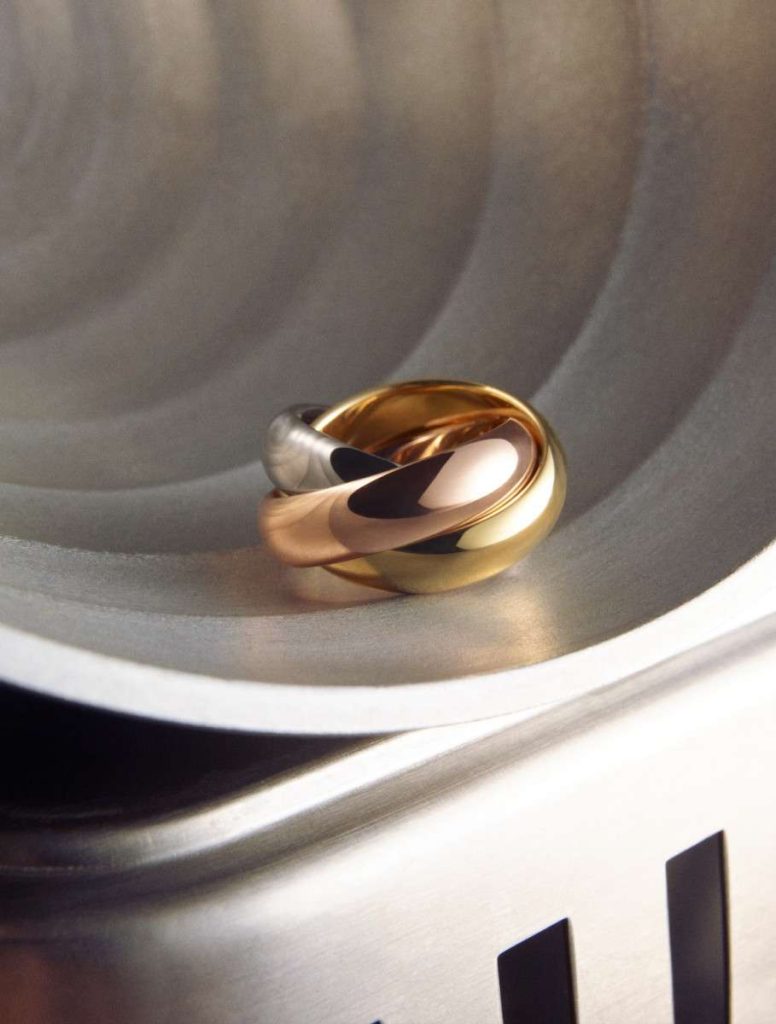
Important pieces include the famous Trinity ring which celebrated its 100th anniversary this week in Paris. The three-ring debuted almost a century ago in 1924 during the heyday of Art Deco. Designed by Louis Cartier at the request of Jean Cocteau, the three interlocking rings are spun of different golds – white, yellow and rose – symbolising friendship, fidelity and love.

The popularity of the Trinity collection grew in the 1950s and 1960s when celebrities including Alain Delon, Romy Schneider, and Grace Kelly were spotted wearing the ring. The beauty of the Trinity was its simplicity and signified that Cartier designs were for a wide array of customers. This allowed the brand to become accessible and renowned not only for high jewellery designs. Its iconic design codes made its way into an array of Cartier products. Today, the Trinity ring is recognised as an icon in the world of fine jewellery and a testament to Cartier’s rich history as well as its innovation. 

History of Cartier
Labrinth wears a Cartier Trinity necklace (Photo by Greg Williams)

For the centenary a new version of the Trinity has been created. The bands have been reshaped and distorted into cushion shaped ‘squared’ links. This first chapter included classic and large models of the ring both in simple gold or adorned with dazzling diamonds, alongside a matching bracelet and pendant. Cartier has also reintroduced the Maximalist Trinity bracelet and increased the volume of all three bands into an extra large piece.

Cartier rose gold Le Voyage Recommencé necklace, ring and earrings, set with coral, onyx and diamonds

The Cartier Panther is another classic design and of course synonymous with the Maison and a constantly reoccurring theme of its creations. The “Great Cat” motif appeared in 1914 as an onyx-spotted panther pattern wristwatch created by the famous French designer Charles Jacqueau.

The initial pattern has evolved to fully sculptured animals, and the array of cats has broadened: to include the striped tiger as well as the panther. It was Jeanne Toussaint, who was known to be a fan of felines, who was nicknamed “The Panther” by Louis Cartier, who became responsible for supervising the cat designs. Along with Peter Lemarchand, she created a variety of jewels which would forever immortalise the feline motif and make it synonymous with Cartier.

Through a century of design, the Cartier cats have gone through various iterations but are still much in demand by jewellery collectors, with designs from the 1980s and 1990s increasing demand.

Cartier high jewellery Nature Sauvage 2024 Iris Velghe
Cartier’s latest high jewellery collection, Nature Sauvage, photographed by Something About Rocks contributor Iris Velghe

Another noted style is Tutti Frutti which was recently spotted on Hollywood superstar Timothée Chalamet. In the early years of the last century Cartier acquired Indian rubies, sapphires and emeralds, carved with floral motifs and these were worked these into a new style of multi-gem jewels which were in contrast to the graphic Art Deco styles that were popular in the time.

Timothee Chalamet Cartier
Timothee Chalamet attends the world premiere of “Wonka” wearing a Cartier Tutti Frutti necklace (Photo by Gareth Cattermole/Getty Images)

The Love and Juste un Clou bracelets are the legacy of Aldo Cipullo, an Italian designer who joined Cartier in New York in 1969 and within two years he had created two icons of the house. The ‘Love’ bracelet, a band in two sections, has to be screwed together with a screwdriver, which is provided by Cartier. Once in a place, the bracelet cannot easily be removed. Cartier made the decision to gift his and her love bracelets to the most famous couples of the era, which included Elizabeth Taylor and Richard Burton as well as Steve McQueen and Ali McGraw.

Stephane Bak in Cartier Le Voyage Recommencé high jewellery
Cartier white gold Le Voyage Recommencé necklace, set with a brown-yellow diamond, sapphires, amethysts, lapis lazuli, obsidian, fancy-shaped diamonds, pink diamonds, brown diamonds and white diamonds; Tom Ford T-shirt via Mr Porter

Meanwhile, another name to note was Maurice Couët, a young clockmaker at Cartier who had been inspired by the magic clocks of illusionist Jean Eugene Robert-Houdin. Couët managed his very own take on these but via a more traditional clock-making route. In 1913, the “Mystery clock” made its debut. What it actually meant was that the hands seemed as though they were floating and no mechanism could be seen, all of which made the clock seem like magic – a trick that stunned staff and clients all at once.

Today, there are arguably a multitude of designs that are instantly recognisable as Cartier: Tank, Trinity, Juste un Clou, Santos de Cartier, Love, Panthère or Ballon Bleu, all of which are based on four main principles of the Maison’s creation. These are the purity of the line, the accuracy of the shape, the precision of proportions, precious details.

Jake Gyllenhaal in Cartier Santos at the Trinity celebrations
Jake Gyllenhaal wears a Cartier Santos watch (photo by Greg Williams)

The maison has also received various royal seals of approval. King Edward VII of England used to refer to Cartier as “the jeweller of Kings and the King of jewellers”. It should come as no surprise then that at the coronation of King George V in June 1911, reportedly 19 of the tiaras worn at the ceremony were by Cartier. In fact, it would be from Spain to England and beyond – Belgium, Russia, India – that Kings and Queens around the world would also make Cartier their official supplier of royal jewellery. As did movie stars and society names of the time, such as Grace Kelly and Elizabeth Taylor.

The Duke of Windsor, at the time Prince of Wales, would also become a client, proposing to Wallis Simpson with a 19.77-carat emerald ring made by Cartier in 1936. He further bought a flamingo brooch in 1940 and a Panthere brooch in 1949 – it featured a 152.35-carat cabochon sapphire.

G-Eazy wears a Cartier white gold Baignoire watch and Dior clothing for the Something About Rocks autumn 2023 issue
G-Eazy wears a Cartier white gold Baignoire watch for the Something About Rocks autumn 2023 issue

King George VI also bought various pieces for his wife, the Queen Mother. And she also inherited some significant pieces from Dame Margaret Greville, notably the Greville Chandelier earrings, platinum and fancy-cut, which were later given to Queen Elizabeth II as a wedding present in 1947. One of the most famous Cartier pieces owned by Her Majesty is the Halo tiara. It was a gift to her on her 18th birthday, having previously belonged to the Queen Mother. It was loaned to the Duchess of Cambridge for her wedding to Prince William in 2011.

Like this? Stéphane Bak models the new Cartier Le Voyage Recommencé high jewellery collection

Sign up to our newsletter

Who is jeweller Meghan Farrell?

New York-based talent, Meghan Farrell, is a modern renaissance woman. She’s an associate producer at a dynamic marketing agency, a trained actress, a photographer and a jewellery maker. Even a cursory glance at her Instagram account @meghan_farrell shows her to be one of those breezy tastemakers who instinctively knows how to package good style, be it via an artfully angled selfie, a panoramic holiday shot or a crisp image of a sleek interior. In short, she has a great eye for design and a knack for making even the most prosaic things look beautiful. It’s no wonder, then, that her jewellery designs – scrollable via @mf_ jewellery – reflect this well curated and creatively edge.

At once effortlessly elegant and playful, her aesthetic is best demonstrated by her signature yellow and white gold ‘Jawz’ design applied to pendants, rings and earrings. The shape is inspired by a great white shark’s open mouth, complete with miniature spikes for teeth, some encrusted with pave diamonds. The popularity of her small but well-considered portfolio speaks for itself: the Haim sisters love her pieces, while Secession actor, Kieran Culkin, has a white gold and diamond Jawz ring that he likes to wear on his right hand.

Meghan Farrell’s Jawz, Sharkbite and Pavé Beat necklaces

“I have always romanticised the films of Steven Spielberg, even though they’re not especially romantic. Jaws was such an impactful movie for me, and I guess I just wanted to capture that vibe. Plus, I love the way the softly curved triangular form suggests the shape of a vagina. There’s a subtlety there,” says the 38-year-old, who was first encouraged to design a range of jewellery by an editor at Teen Vogue while she was interning at the magazine as a college student. After acting school, she worked in fashion retail and was snapped up by Opening Ceremony in New York. “The team brought me into meet [founders] Humberto [Leon] et Carol [Lim], and within a week, I was one of the assistant managers at the [Soho] store, dealing with celebrity clients and VIPs. Then, I was promoted to assist assistant buyer and sourcing all the accessories by myself,” she explains.

Meghan Farrell
Meghan Farrell’s Skip Beat ring

At the time, Opening Ceremony was blazing a trail in the fashion industry and Farrell was seemingly riding on the crest of a wave, yet the urge to create was too strong for her to resist. In the evenings, she attended a bench jewellery workshop at New York’s Fashion Institute of Technology (FIT), eventually progressing to a more technical class which allowed her to design digitally using Rhino and CAD software programmes.

Sticking to a rigid career path was never an option for Farrell and it’s certainly a life choice that’s paid off, allowing her to be inventive on her own terms. Her jewellery pieces are emotive things, made according to her own passions and adventures. For example, her hugely popular Heartbeat range, which riffs off the spiky patterns made by an electrocardiogram, was in fact inspired by the ‘rhythm’ of a personal relationship:

Meghan Farrell
Meghan Farrell’s Beat Beat ring

“I was DJ-ing at the time and I was in love with someone who was a drummer. I also worked in fashion with [British stylist and Fashion Consultant] Kate Foley and she had these beautiful finger tattoos, so I toyed with that idea for a while. I drew a heartbeat on my finger and the pattern for those pieces just came from that as an expression of love,” says Farrell who also likes to foster a touch of mystery in the hearts and minds of her customers. “I love that the line looks like a squiggle, a little Elsa Peretti in spirit, so it draws you to the romance of the past, but it secures you in the energy and possibilities of the present.”

Like this? Karla-Simone Spence talks jewels, acting and The Confessions of Frannie Langton

Inside the making of Jessica McCormack’s diamond rainbow earrings

Photography by Casey Moore, Words by Jessica Bumpus

Even though Jessica McCormack confesses she’s not really the chandelier-y type when it comes to earrings, she says “there is always a moment” for something with more than a single stone (the designer, who hails from New Zealand and established her business in 2008, has developed a knack for antique- meets-modern pieces that sometimes incoporate several great diamonds).

Take the Diamond Rainbow Earrings, one of McCormack’s latest showstoppers, for instance: an elegant and elongated arching design – she thinks it’s one of the biggest the maison has made for some time – that features a mesmerising combination of marquise, heart, baguette, round, oval, pear and cushion diamonds that line its bold, Art Deco- esque curves. When worn, the diamonds move and swing; it’s definitely something to showcase with your hair up. All stones sit in their own collet (a device that holds stones in place), and each one is attached to a neighbouring collet via a small hinge. It is an incredibly labour-intensive part of the process, which, all in all, has taken around a year, from inception through to completion.

It was last summer when McCormack – who can count celebrity fans in Reese Witherspoon, Charithra Chandran, Carey Mulligan and Sienna Miller – had the idea of doing something “super fun,” she says, nestled on an armchair from inside the library of the Carlos Place townhouse, in which her company’s HQ opened in 2013. “And I thought the whole rainbow idea was happy.” It might have had something to do with Pride; it might have had something to do with the rainbow as a symbol of hope during the pandemic. She felt it was the right moment and sort of made sense. The rough draft was a “napkin kind of sketch,” she says, laughing. “I think of a woman [when designing]… she’s a chic woman.”

Jessica McCormack

McCormack’s signature designs are typically created in mind for the humble white T-shirt and for moving between boardroom and the school run; it’s an ethos whereby diamonds aren’t saved for exclusive events. This piece had, however, initially been thought of as being worn with a black smoking jacket, or a gown, and destined for the red carpet. Yet, even with the grandeur of the design (and awards season being just around the corner), McCormack can’t help but feel the piece will get snapped up as a Christmas present for a very lucky someone. Crafted in white diamonds (McCormack also confesses not to be one for colour – though she could, she says, perhaps imagine this in pastels), it took a huge amount of time to find the right stones, and there are, after all, a fair few of them on this piece.

Next came the mount, then the stone cutting, stone setting, polishing and assembly. “Just send me one!” she jokes, eager to see the final result, which is imminent when we speak. The earrings, which took roughly 80-100 hours to make, will have passed through seven or eight pairs of hands within the atelier team, who you’ll find at work in the basement.

Everything has been handcrafted and constructed methodically and constantly so that the piece is never not being worked on, with a lot of pre- legwork put in. “To make things look very relaxed and chilled takes quite a lot of effort,” notes McCormack of the technicalities involved. “The homework, everything is there.” In terms of settings and techniques, the Diamond Rainbow Earrings combine a lot of the signature Jessica McCormack motifs. Notably, the metal has been blackened, which makes the diamonds pop and creates that rock ‘n’ roll edge the brand is known for – a cool factor; modern.

Designs for the Diamond Rainbow Earrings, one of McCormack’s latest showstoppers: an elegant and elongated arching piece that has a red-carpet grandeur

There is also the cut-down setting, where the white gold metal is pushed down over the stone to secure it, and then cut away at a steep angle from the girdle, leaving raised grains to set it; the milgrain setting, which is often described as being “tiny dots” along the edges of a piece. Milgrain is a technique where small beads of metal are used to create a decorative border. And there’s also the channel set, whereby stones are placed along a track between two walls of metal. The stones are nestled against one another and not separated by prongs, beads or bezels.

Moreover, as the cut-down set is a Georgian technique, and the milgrain was popular in Art Deco jewellery, it is clear that McCormack was keen to mix different eras within the design. Prior to establishing her brand, she worked for Sotheby’s, in the jewellery department; and growing up, her father was an auctioneer – and so a love for things from the past has always been a part of her life and an influence in her work. “I’m always trying to work towards that juxtaposition of old and new and from that creating something that is perfect,” she says.

Like this? Meghan Markle wears Princess Diana’s Cartier watch in new Netflix series

Lauren Harwell Godfrey talks jewellery for social change

Lauren Harwell Godfrey is going through “a bit of a fire opal phase” right now. The San Francisco-based creator, who speaks to me via Zoom from her studio, is busily unpacking some of her latest talismanic jewels on the eve of an important trunk show and focuses her phone camera on an extraordinary pair of opal drop earrings. “I love a crazy gemstone colour combination. These have canary-yellow tourmalines next to the bright-orange fire opals, next to cool-blue turquoise. It’s like candy,” she tells me. “Fire opals really spoke to me at Tucson [Gem and Mineral Show] this year. I go through phases of loving certain colours, and I just really fell for their cheerful, optimistic shade. Maybe it’s just what we all need right now.”

Harwell Godfrey is somewhat of an authority on feel-good jewels. The former advertising art director and food stylist started making “fun, festival-type jewellery with bits of leather and crystal,” for herself and for friends as a creative outlet, before launching her eponymous fine-jewellery brand in 2017. “I was like, ‘Okay, I love fine jewellery and I feel I could design it well,’ so I reached out to my friend, Randi Molofsky, who runs a brand development agency called For Future Reference, and they all just took me under their wings and helped me produce my first collection,” she explains.

In just five years, Harwell Godfrey’s colourful, richly textured gold and gemstone pieces – which she describes as “maximalist and geometric” – have amassed fans from Cynthia Erivo and Blake Lively to Kamala Harris, and garnered their creator a clutch of covetable accolades, including the 2022 Gem Award for Jewelry Design, and, as of the time of writing, a nomination for Emerging Designer of the Year by the Council of Fashion Designers of America – the only fine jeweller put forward in this year’s category.

Lauren Harwell Godfrey
Lauren Harwell Godfrey lensed by Tricia Turner Studio

“It feels amazing, for sure, because I still feel like the new kid on the block in some ways,” she says of the industry recognition. “But I also take it as people really getting behind what I’m doing, so I get to keep doing it. I see it as an honour that I need to keep living up to.”

Another major source of motivation is the need for her pieces to give back. In early 2020, Harwell Godfrey introduced her first Charity Heart pendant, to raise funds for causes such as the World Central Kitchen, which, as part of their mission, supported families in need of help during Covid. Following the murder of George Floyd, she also created a sleek black onyx version to benefit the National Association for the Advancement of Coloured People. Since then, other hearts have benefitted Human Rights Campaign, Every Mother Counts, and Futures without Violence, where Harwell Godfrey is also a board member.

“It didn’t take me long to figure out that I wanted to use my platform and position to make jewellery that could affect social change, to fight for our sisters and brothers and anyone who needed us,” she says. “We’re in a broken country right now and we must do what we can to fix it, so we’ll keep these designs going and keep partnering with good causes. I think, of all the pieces I’ve made, I’m proudest of these hearts and the money that’s been donated through them. We’ve just gone over the $250,000 mark, and I’d love to keep that going.”

Harwell Godfrey is also a keen believer in jewellery’s ability to affect change on an individual level. “I wear my grandmother’s diamond ring and I think it helps me hold on to her, in some way. My engagement ring, too, has a diamond that holds a special energy for me. I do think stones can hold energy. Turquoise, for example, makes me feel really calm whenever I wear it,” she says.

Lauren Harwell Godfrey lensed by Tricia Turner Studio

The jeweller also says she creates every piece with a good intention. “I even put little engravings on the backs of a lot of them… I just think that if I put my pieces out there with positivity, somehow it will get around. Jewellery is my way of connecting with people.” To keep the good vibes in full flow, the designer works to music. “A lot of the time, it’s jazz. I even named my son Miles, after Miles Davis. But Bobbi Humphrey’s always playing, too, and Frank Ocean. I’ve also been listening to Thundercat and Phoebe Bridgers – they’re enormously talented.”

And while Harwell Godfrey doesn’t tend to work with a physical mood board – “it’s all in my head” – she has filled her lavender-coloured studio with trinkets and treasures sourced from markets all over the world, such as a wooden African mask found during a trip to Marrakech, gleaming mineral geodes, and a gilded textured mirror “stolen” from her own home. “They’re all things that I’ve collected over time and that mean something to me. I wanted this space to feel like an extension of me. I even put in a gold beaded curtain and painted gold stars all over the place, so that when clients come in, it feels like they’re a part of the Harwell Godfrey universe,”
she says.

In the coming months, that universe will only be expanding. “I’m definitely on a mission to keep growing this brand and keep making positive things to send out into the world,” enthuses Harwell Godfrey. “We’ve got a little capsule collection coming out towards the end of the year, which I’m really excited about, and I’m hoping to launch another collection with more of a protective quality to it, since there’s been so much discussion about the rights of women to our own bodies, and how those bodies are being legislated by men. I wanted to make something happy and joyful that also felt empowering for us. And I’m sure there will be more charity hearts to come. I’d love to hit the million-dollar-donation mark with those.” A big ask, indeed: but if anyone can achieve that, it will most certainly be Lauren Harwell Godfrey.

Like this? Discover the best engagement rings for festive proposals

Meet LA jeweller Suzanne Kalan and her trendsetting baguette diamonds

Photography by Lucy Sparks, Styling by Felix Bischof, Words by Ian Thorley

I’m supposed to be meeting one of LA’s premier jewellery designers for lunch at Avra, a glitzy fish restaurant in uptown Beverly Hills. However I’m already running twenty minutes late, and I’ve been sitting in nose-to-tail traffic for over an hour as I drive from Santa Monica, a journey of just a few miles, and my traffic app is still telling me I’ll be another ten minutes.

Embarrassed, I call Suzanne Kalandijan on her mobile to explain my situation. “Relax Ian, this is LA,” she says laughing, “and take your time, the traffic here is so crazy that I only make one appointment a day”, instantly putting me at ease. When I eventually meet her, thirty minutes late and slightly clammy, she’s relaxed and happy, a successful woman at ease and confident in herself. In a career of nearly forty years, Kalandijan has become one of America’s most successful jewellery exports. Her playful designs are available in all the best places, namely at Net-A- Porter, Neiman Marcus, Bergdorf Goodman, Bloomingdales, and Goop, as well as international retailers such as Harrods, Dover Street Market and Lane Crawford to name a few.

Suzanne Kalan white gold tennis necklace with blue sapphires and white diamonds
Suzanne Kalan white gold tennis necklace set with light blue sapphires and white diamonds

The jewellery scene in Los Angeles is booming. There’s a plethora of successful designers – including Jacquie Aiche, Anita Ko and Emily P Wheeler – and the style here is relaxed and casual, combining an easy mix of diamonds with denim and sportswear. The success of the city, Kalandijan tells me, is because “the rest of the world has always had a liking of American culture, especially for all things Californian.”

This is a business where it’s difficult to be unique. Brands with a rich archive and heritage reign supreme, making it much harder for new labels to be established. However, Suzanne has managed to carve a niche that’s not only unique but instantly recognisable to her. She was the first jewellery designer to use off-cut baguette diamonds and coloured stones, which were then arranged in a seemingly haphazard fashion that was reminiscent of fireworks exploding. And that’s how her best-known line got its name – the Firework collection.

Kalandijan was born in Lebanon to Armenian parents. Her father and most of her family were in the jewellery trade. “It’s a common trade amongst Armenians,” she says offhandedly. The family later moved to Montreal, Canada where she grew up before heading to LA aged eighteen where “my father opened up a jewellery store in downtown LA, which is known as the jewellery district,” she explains. Becoming a jewellery designer wasn’t always the chosen path for her. For the first ten years of her career, she worked in retail, in her father’s store with “all my cousins, my father’s cousins, they were in the business and had the manufacturing and all that”.

Suzanne Kalan rose gold bangle set with rainbow sapphires and white diamonds

After marrying her husband Paul they started a family and she inadvertently started on a path to becoming one of LA’s most beloved jewellery designers. She was a young mum at home with a new “quiet baby” and this gave her a craving to do something else with her life.

“I thought I was gonna go crazy, sitting at home doing nothing. So, I started making some fashion jewellery, fun jewellery for myself and my sister. And that’s how this whole thing started.” The business launched in 1988, the family name shortened for ease from Kalandijan to Kalan, and financed by the sale of a wedding present, a diamond tennis bracelet from her parents. The initial focus was making inexpensive jewellery pieces, a high-volume business that the whole family could be involved in – roping in her sister, cousins, husband and his family onto an at-home production line. She recalls the advice of a friend that saw her switch to precious metals: “a friend of my brother was a rep to the major department stores and she said, “Listen, all my buyers are sterling silver buyers. If you make the same product in sterling silver, then I know I could sell this.” From there the business grew and we got our first order. That first year I sold $400,000”.

Suzanne Kalan rose gold ring set with a dark grey pearl, purple sapphire baguettes and white diamonds

By the early 2000s, she expanded the brand and became even more luxurious. “Eventually we came up with the Fireworks collection,” says Kalandijan. “But even that was a struggle in the beginning because no one wanted to touch baguette diamonds back then”. The Fireworks collection is a vibrant collision of diamonds, emeralds, sapphires, and rubies, each cut in the traditional baguette shape. They are then tilted, clustered and arranged in a seemingly random explosion of light and colour. Mimi Hoppen, the Director of Jewellery at Dover Street Market, explains the Kalan phenomenon: “Suzanne Kalan has been fundamental to setting and driving the trend for baguettes and is so creative in using this cut. Clients are always drawn to her colourful sapphire baguette rings in particular.”

Suzanne Kalan yellow gold eternity ring set with light blue sapphires

Kalan followed up the Fireworks line with the Vitrine collection, custom cutting the gemstones to have both a flat top and bottom. This created a window effect, allowing for diamonds set below the gemstone to be clearly seen. The Vitrine concept is yet another new and interesting way to look at gemstones, both at them and through them.

Her daughter Patile joined the business in 2012 and created a more accessible line of 14-carat jewellery called KALAN by Suzanne Kalan. Kalandijan has been looking at expanding this offering and recently started reimagining her Fireworks collection with men in mind. Key pieces range from white diamond dog tags and eye-catching pink sapphire eternity bands to chic emerald-green bangles.

Suzanne Kalan yellow gold hoop earrings set with thick baguette emeralds

Meanwhile, she’s continuing to look at more creative opportunities. In October 2021, Kalan teamed up with the Cultured Pearl Association of America (CPAA) to create a capsule collection featuring Tahitian pearls. The glittering line-up of earrings and rings celebrates the rich undertones of black Tahitian pearls, which can appear blue, green, purple and pink depending on the light.

With her finger in every pot, Kalan puts her success down to a uniquely holistic approach to jewellery making. “I think the really successful designers think of everything, not just what I feel like designing right now or not just about business,” she says. “Don’t think about business only and don’t think about design only. You have to think of the whole picture.” And with that, she got up and left leaving me to muse my Waze app and the hideous thought of getting back in that traffic.

Jewellery assistant Joshua Hendren

Like this? Read about LA’s jewellery design stars