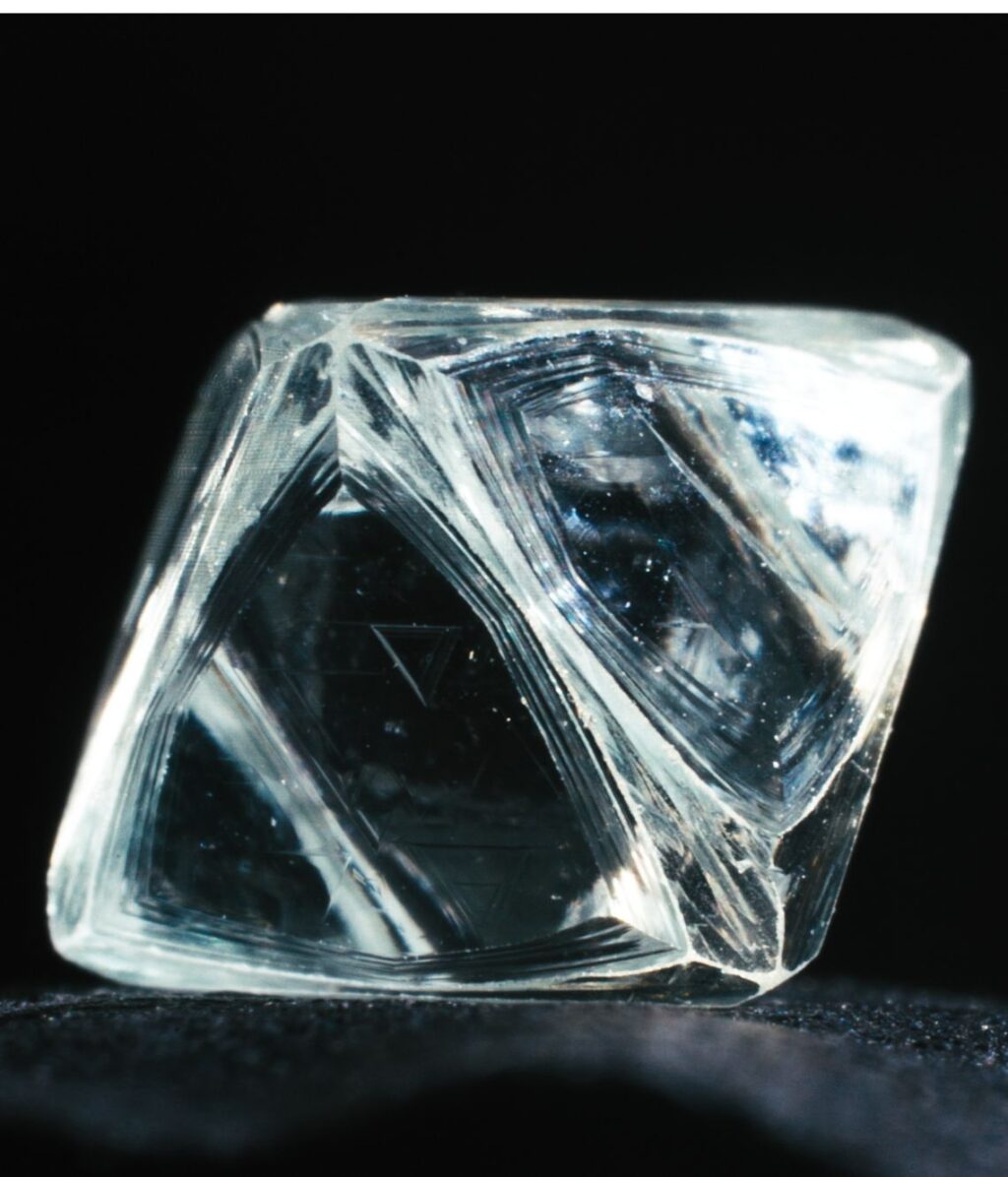
Long before a natural diamond becomes a jewel – or even takes shape deep within the Earth – its story begins among the stars. This October, De Beers will invite visitors to discover that hidden world through an immersive installation at Frieze Masters in London, as part of its autumn cultural programme.
Voyage Through the Diamond Realm, Chapter II: On the Birth of a Diamond will unfold across three rooms at Frieze Masters, held in Regent’s Park from 14 to 18 October. Bringing together art, geology, film and sound, the experience follows carbon as it transforms into a natural diamond, while also celebrating the craftspeople and creative traditions of Botswana, where many of De Beers’ natural diamonds are mined.
The installation begins with a five-metre handwoven tapestry by Shifron Mercury Studio, the Paris-based practice founded by artist-designers Goni Shifron and Gabrielle Laurin Mercury. Created using natural fibres from Botswana’s Okavango Delta, its richly layered surface evokes the geological depths in which natural diamonds form. Ceramic fragments inspired by the irregular contours of rough diamonds are woven into the work, alongside ostrich-eggshell beads.
The tapestry will be shown alongside 47 amulets commissioned by Botswana’s Mabeo Studio. The studio collaborated with 41 basket weavers, potters and wood carvers from across the country on the amulets, which were handcrafted from local materials and set with De Beers natural diamonds.
The making of the five-metre handwoven tapestry by Shifron Mercury Studio. (Shifron Mercury Studio)
Born in the stars, formed in the Earth
In the installation’s second room moving image, narration and an enveloping soundscape will tell the story of carbon travelling from its earliest iteration within ancient stars (carbon atoms were created inside stars and dispersed into space when those stars died) to beneath the Earth’s surface, where extreme heat and pressure worked to transform them to the coveted diamonds they are today. The film is narrated by actors Lucian Msamati and Kristin Winters, with voices and original work by artists including Mumsy Themba and Ecka Mordecai.
The installation is the second chapter in De Beers’ ongoing Voyage Through the Diamond Realm series. Its first Frieze Masters presentation in 2025 explored the myths and legends that natural diamonds have inspired across different cultures, and later travelled to Mumbai and New York.
The 2026 installation forms part of De Beers’ autumn cultural programme, which also included a partnership with Homo Faber in Venice this September. At Homo Faber, a biennial exhibition of contemporary craftsmanship held at the Fondazione Giorgio Cini in Venice, De Beers supported artists Abongile Sidzumo and Shakunona Parata in celebrating Southern African craft traditions through live leatherworking and basket-weaving demonstrations using locally sourced materials.
Botswanan artist Shakunona Parata (right) practises a centuries-old basketry craft, which De Beers showcased at Homo Faber. (De Beers Group)
A pink palace in one of the island’s peaceful spots, The Ritz-Carlton Abama rises up the foothills of Tenerife’s Mount Teide. Inspired by Moorish architecture, it has the feeling of a small village, sprawling along the arid coastline where the Atlantic crashes into jet-black rocks and splits the sunlight into a spray of diamonds.
There is a huge, spectacular Championship golf course and plenty else to do as well — an extensive Roman spa, a tennis academy, water sports, yoga (and aerial yoga), miles of hiking trails, seven pools, a beach, and ten restaurants. And this is also one of the world’s best astrotourism spots.
The Ritz-Carlton Abama, Tenerife
Here, where the cold water currents of the Atlantic meet the searing African desert winds, the nights are dark as prehistory — a fact that has beckoned the world’s top astronomers, physicists and cosmologists to the island. When Tenerife hosted Starmus (the global gathering bringing together science and art), the late Stephen Hawking lectured at The Ritz-Carlton Abama on the origin of the universe and black holes.
The Ritz-Carlton Abama, Tenerife
Today, the hotel offers expert-guided star-gazing sessions, but to make the most of the night sky join the small percentage of visitors who make the twisting ascent to see some of the world’s most powerful telescopes — giant, bulbous white towers, perched at the top of Mount Teide.
It’s just over an hour’s drive from the Abama and you can hire a car at the hotel. The surrounding national park is a Unesco-sanctioned Starlight Reserve — a location where efforts are made to preserve darkness and starlight by fending off light and air pollution — and visitors can observe constellations with the naked eye. Little magnifies the nanosecond that is human life as acutely as staring at the endless starlight of the Northern and Southern Hemisphere blanketed overhead.
The Ritz-Carlton Abama, Tenerife
Back at the hotel, it’s a case of swapping star constellations for Michelin stars: the gastronomy is the other reason guests flock here. The Japanese restaurant, Kabuki, has one-star and serves melt-in-your-mouth sashimi, an experience undoubtedly enhanced by the stunning panoramic terrace.
The Basque restaurant, M.B., is the only place in Tenerife to hold two Michelin stars. Its chef, Martin Berasategui, frequently features in the ‘world’s best chefs’ list and also has another restaurant at the hotel, Txoko, serving up small plates such as Cantabrian anchovies and chistorra sausage, and at least ten different steaks. For sundowners — followed by the seafood paella — head to El Mirador, with its views of La Gomera island. The hotel can also arrange a gastronomic tour of the island, as well as wine tasting at Icod de los Vinos, where wine was first produced back in the 17th century.
The Ritz-Carlton Abama, Tenerife
The resort is set in huge swathes of tropical gardens, with palms and banana leaves, cacti and colourful flowers. Steps away are the parasols and sunbeds of Playa Abama beach, which guests reach by cable car down from the hotel, while the fishing village of Playa San Juan with its restaurants and shops is a five-minute drive (and about seven euros in a taxi).
The Ritz-Carlton Abama, Tenerife
For the best room in the house, check into the 10,000 square-foot, four-person penthouse Imperial Suite, with two spacious king-size bedrooms and its own private wraparound rooftop deck complete with heated pool, outdoor dining and cabana — and the perfect place to start your own extraterrestrial explorations.
The largest of the Italian lakes and arguably the most beautiful, Lake Garda has been the lavish holiday retreat of ancient Roman writers through to modern European royalty. Today, many mansions and farmhouses have been transformed into designer resorts — and the latest Borgo Tre is a charmingly renovated 18th-century farmhouse surrounded by cypress and olive trees and set just a few steps from Lake Garda.
Owned by the Hinteregger family who run Sonnwies (a family eco wellness hotel in South Tyrol) the six apartment-style suites have a whirlpool and garden. There’s a heated outdoor pool made from local granite, and a mini spa with a yoga terrace, outdoor cabanas, a cold tub and a Finnish sauna.
Located a ten-minute walk from the restaurants of the small mediaeval town of Torri del Benaco, close by is the romantic peninsula of Punta San Vigilio, the sheer cliffs of Monte Baldo and the biggest island on the lake, Isola del Garda.
A render of Wilderness Mokete, Okavango Delta, Botswana
One of the world’s best places to watch wildlife, the Mababe region in Botswana can feel like the last remaining true wilderness. Peaceful from anthropogenic noise, the birding is fantastic, as is the megafauna with huge herds of elephants and buffalo roaming the land.
Lions hunt throughout the day, while clans of hyenas match their wits against other predators. It’s a thrilling, non-stop show where Planet Earth III filmed the wild dog hunt.
Set on the eastern fringe of the Okovango Delta, south of Chobe, the new off-grid Wilderness Mokete camp is a limited-edition safari concept from Wilderness. Set in uncharted safari territory, the camp can only sleep 18 guests and will be open for just two years. As Africa’s leading sustainable operator, Wilderness introduced its first community equity camp in Namibia back in 1996. With 2.3 million hectares in its custodianship (an area roughly the size of Finland), the ambition is to double this by 2030, bringing ecotourism to regions in need.
Wilderness Mokete, criss-crossed by animal trails, has nine en-suite canvas tents with their own private plunge pools, a tented lounging area and a swimming pool connected by wooden walkways. But the real highlight is the game drives: with no other commercial properties in the area, guests can spend hours spotting wild dogs, elephants, impala, buffalo, birds, lions, leopards and red lechwe. At night, a retractable roof means that the wildlife watching can continue as you fall asleep under a galaxy of stars.
At 38, Frida Escobedo became the youngest architect to create the Serpentine Pavilion. In 2022, the Metropolitan Museum of Art selected her to design the new $500 million modern art wing. And it’s likely only a matter of time before Escobedo’s latest project, a seaside hotel on the Yucatán Peninsula, starts winning accolades.
Set on the Lagoon of the Seven Colors, close to the Belize border, 26 light-filled treehouses suspended on stilts raise guests into the leafy jungle landscape. Most have private pools, terraces and panoramic views through double-height windows. Emerald subway tiles frame the pool, where hammocks are strung across the water. Part of Design Hotels, the resort will set the new standard for slow living, combining therapeutic programs with time-honoured rituals to deliver best-in-class therapies.
Escobedo is known for her sensitive use of material and attention to ecological and socioeconomic issues. The treehouses are built from FSC-certified tropical hardwood, while the stilt design reduces the environmental impact on the landscape; local artisans crafted the resort’s furniture using recycled wood from a local plywood processor; while an on-site treatment plant ensures no wastewater ends up in the lagoon.
In addition, working with community, nonprofit and academic organisations, the resort is helping rehabilitate the area’s mangrove ecosystem and expand the natural habitat of the local spider monkeys, who delight in roaming the property.
Arguably, 2024’s big draw in wellness will be Mexico. As well as an abundance of shamans and healers, there’s the ground-breaking Rancho La Puerta in Baja California, the exceptional Chablé properties in Yucatán and Maroma, and the wellness-minded Habitas Bacalar.
This month sees the opening of the first overseas outpost of the award-winning Spanish SHA Wellness Clinic, long a destination holistic retreat for celebrities, professional athletes and heads of state, among others. A 30-minute drive north of Cancun airport, the new SHA Wellness promises to be as languidly seductive as the first. Set in seven hectares, framed by a long white sand beach fronting onto a sea of many shades of aquamarine and the largest coral reef in the northern hemisphere.
Different species of turtles arrive every year, while colonies of pelicans, herons and frigates arrive with the sun’s first rays. The new resort minimises environmental impact using mostly natural materials and renewable energy.
SHA’s intensive science-based programmes cover detox, weight loss, stress, anti-ageing and rejuvenation using methodology including metabolic analysis, neurocognitive assessments and 3D body scanning, as well as looking at diet, psychological sessions and emotional coaching. It’s an opening that will elevate Mexico to the level of long-haul wellness hard-hitters, Thailand and India.
Maybourne is the group behind London’s most legendary hotels: Claridge’s, The Connaught and The Berkeley. Next year, The Emory will become the group’s first opening in the capital since 1972.
An architectural masterpiece designed by the late Richard Rogers, this all-suite hotel will be the ultimate in discreet luxury from the private, understated entrance on Old Barrack Yard, through to the hotel’s rooftop, with a 360-degree view of the capital and only accessible to the hotel guests.
Nine world-class interior designers (including Pierre-Yves Rochon and Patricia Urquiola) were responsible for each different hotel floor. Chef Jean-Georges Vongerichten will bring his Manhattan ABC kitchen to London for the first time, there will be a four-storey subterranean wellness space, and at the helm will be award-winning general manager, Knut Wylde who will be running things with his usual impeccable style.
The former Palace of Justice in Amsterdam started life as an orphanage and has been revamped many times over the centuries. Today, its latest imagining is as a luxurious Rosewood hotel.
Architects David Archer and Julie Humphryes (previous work includes Hollywood’s Chateau Marmont, The Shard and the National Gallery) have retained the unique character of the former staterooms with their high ceilings, wide doors and enormous windows, overlooking iconic townhouse rooftops and the Prinsengracht (the Prince’s Canal), one of the city’s most beautiful waterways.
Set in the UNESCO World Heritage-listed Amsterdam Canal District, a focal point will be the courtyards, each from a different century, which will blossom into three lush gardens.
One of only seven Ritz-Carlton Reserves in the world, Nujuma — designed by architects of Foster + Partners — will take barefoot eco-lux to new levels. In one of the most seldom-visited areas of the Red Sea, a remote virgin coastline of beaches and dunes, Nujuma sits on an archipelago of previously uncharted islands accessible only by chartered boat or seaplane.
Part of the world’s most ambitious tourism project, this promises something remarkable: to add to the conservation value of the landscapes by 30% over the next two decades. Two million trees destined for rewilding projects are maturing in landscape nurseries, while a lab-grown coral garden opens up new possibilities for reef regeneration.
The resort will be carbon-negative, with zero waste to landfill, zero waste to sea and zero single-use plastics, which is just as well since the region is home to endangered hawksbill sea turtles and Indian Ocean humpback dolphins, as well as over 130km of pristine coral reef.
The water and beach villas will have one to three bedrooms, surrounded by clear waters and white sandy beaches. There’s a world-class dive centre, or guests can kayak through mangrove forests, hike nearby mountain trails or discover the sweeping desert dunes and canyons.
Little is as thrilling as a bumpy arrival by seaplane in the Maldives — particularly if arriving at a Soneva resort. If there’s one person responsible for bringing eco and luxury together in travel, it’s the co-founder of Soneva, Sonu Shivdasani. The original pioneer of laid-back barefoot luxury, Shivdasani first visited the Maldives in 1987 with his wife and co-founder Eva, before setting up Six Senses in 1995. Although they later sold the group, they retained their favourite property: Soneva Fushi, groundbreaking for being the first sustainable resort in the Maldives, famous for its “no shoes, no news” policy.
Followed by Soneva Kiri in Thailand in 2010, and Soneva Jani in 2016, February sees the new arrival of Soneva Secret, which promises to raise the bar once more. The first resort in the Haa Dhaalu Atoll, Soneva Secret features just 14 overwater and island villas, including the Maldives’ only floating villa.
Each will have a dedicated chef, gym, spa treatment room and retractable roof for stargazing — and most will have Soneva’s iconic slide into the sea. And there will be a plethora of bucket-list activities on offer from dolphin sunset cruises, swimming with manta rays and turtles, an observatory with a resident astrologer, castaway picnics, a dive centre, a world-class spa and superb restaurants and a wine cellar. This will be the Maldives at its sustainable and magical best.
One of the most ambitious of London’s regeneration schemes, at the heart of the epic, £3 billion development of Queensway is the former department store, Whiteleys.
The building’s new masterplan defined by its unique art deco architecture and 100-year-old Grade II listed façade, includes London’s first Six Senses with 110 guest rooms and suites, 14 residences, a social and wellness club, a cosy lobby bar and lounge, an all-day restaurant with open kitchen, courtyard and beautiful Six Senses spa.
Set in a space reminiscent of an old-fashioned London underground station, spa highlights include a 20-metre indoor swimming pool, alchemy bar and a relaxation room with vaulted ceilings.
Rocco Forte House is your private hideaway in a 19th-century Milanese palazzo with eleven apartments, a communal rooftop area, and a private chef, butler and sommelier on speed dial. The concept is the latest offering from the luxury hotel brand – and Milan will be the second opening following Rome.
It promises your own pied-à-terre at one of the city’s most exclusive addresses: the narrow, paved Via della Spiga, which is the artery of the fashion district where neighbours include Prada, Dolce & Gabbana and Tod’s. Beautifully restored to its original splendour under the discerning eye of Olga Polizzi (Rocco Forte’s director of design) the apartments are detailed with mouldings, frescoes and marble floors.
Originally opened as a hotel in 1912 on the instructions of King Alfonso XIII, this regal building takes up a full block across from Plaza de Neptuno — an indication of its importance — and has a century’s worth of tales to tell. Exotic dancer and spy Mata Hari based herself here, Ernest Hemingway wrote here, while Pablo Picasso, Orson Welles and an unknown Salvador Dalí all checked in.
But Madrid’s grand dame was due for a facelift and next year the hotel will reopen as The Palace, a Luxury Collection hotel. The new aesthetic created by Barcelona-based interior designer, Lázaro Rosa-Violán will retain the century-old grandeur, but lose the pomp.
Rosa-Violán, a painter for eight years and an architect for twenty, fills his projects with one-of-a-kind elements: an ancient Chinese screen, a 200-year-old map or a series of vintage photographs. No doubt the new lavishness would have impressed King Alfonso himself.
To celebrate the 60th anniversary of cinema’s most famous film franchise, Black Tomato was appointed the official travel partner to curate James Bond-inspired trips.
The 007 ski adventure in the Austrian Alps starts with an undeniably cinematic experience. Before the lifts open, guests will ascend the Gaislachkogl mountain by snow-groomer to make the first tracks of the day. Breakfast and Bollinger are served at the summit from the ice Q restaurant, a beautiful glass box that appeared in Spectreas the futurist hospital.
Next, there’s a private tour of 007 Elements, an exhibition profiling the high-tech world of Bond with the option to be accompanied by Oscar-winning special effects coordinator Chris Corbould OBE, who worked on fifteen of the franchise’s films. Sölden is the only ski range in Austria offering three peaks at 3,000m or higher, with lift access — and for those wanting to be more Bond, there’s the chance to conquer all three in one day in a thrilling off-piste adventure with your expert ski guide.
If the terrain looks familiar, Bond skied here in 1977 in The Spy Who Loved Me, in 1999 in The World Is Not Enoughand in 2015 for Spectre. For the most charming place to stay, check into the newly-renovated Das Central, where the vast rooftop has an infinity pool providing a pan-orama of the peaks. The buffet breakfast here is arguably one of the best in the world.
Ready, Set, Ski
F&P Travel’s new family chalet
Organising a family ski holiday can be as stressful as planning a wedding: choosing the perfect resort, renting equipment, booking ski schools and finding babysitters. F&P Travel’s new family chalet experience in Méribel hones all those essential details, genuinely taking the hassle out of family skiing.
Everything that could make family skiing simpler is covered, from boot fittings in the chalet to a driver to transport children to ski school, as well as home-cooked teas, pizza-making classes, free babysitting, sledges and every piece of equipment you could want from monitors to sterilisers.
Peak of Good Taste
Sciare Con Gusto
After a morning of mountain air and skiing, little is better than freshly cooked, hearty fare. Alta Badia – in the corner of Italy’s Südtirol, including the ski areas of Corvara, San Cassiano and La Villa — is Europe’s leading gourmet ski destination. Each ski season, chefs from the dozens of local Michelin-star restaurants head up the slopes to serve their signature dish in huts scattered across the mountains, accompanied by ‘sommeliers on the slopes’ on hand with South Tyrol’s finest wines.
The launch of a new flight means the Michelin stars of the slopes are more accessible this season. The new airline Sky Alps will see a fleet of Dash DHC-8-Q400 aircraft, each seating up to 78 passengers, flying from London Stansted to Bolzano, the gateway to the Dolomites. This season, there are also new suites at perennial fa-vourite La Perla, while the Pralongiá mountain hut — originally opened in 1932 and the oldest and highest hut on the Pralongià plateau — re-opens with a brand new bar, restaurant and rooms.
Finally, the traditional South Tyrolean family-owned Hotel Sassongher is taking guests ice climbing across frozen waterfalls and icy spiny ridges with experienced Alpine guides.
Cold Mountain
Poiana Brasov mountains in Romania (Photo: Kempinski Hotels)
Romania is a place of snow-capped peaks and dense forests, impeccable settings for the folklore that originates from nearly every region (werewolves and vampires, anyone?). One of the country’s geographical wonders is the Carpathian Mountains, Europe’s last great wilderness of over six million hectares of forests where bison, beavers, bears, wolves and lynx roam — and some of the most spectacular mountains in the world.
Here, the town of Poiana Brasov, the country’s best-known resort and location for the Anthony Minghella film Cold Mountain, is set to become the new must-visit winter destination. The Kempinski Poiana Brasov mountain resort will be the first five-star hotel in the Transylvania region and promises to be a luxurious hideaway with direct access to almost 24 kilometres of ski slopes on the flanks of the Postăvarul Massif, which has 11 lifts and offers some of the best beginner, lower intermediate and family skiing. Warm up after a day on the slopes with a Carpathian Single Malt, Romania’s first whisky.
China’s Feeling for Snow
The Shanghai Yaoxue Snow World Complex
Nearly 20 years after Dubai achieved the seemingly impossible by creating a ski area in the desert, China is opening its snow resort in the middle of Shanghai to rival Ski Dubai. After winning the 2022 Winter Olympics, the People’s Party hoped to create 300 million Chinese “winter sports enthusiasts,” cultivating the greatest snow sports boom the world has ever seen.
Multibillion-dollar resorts are popping up in record time. The latest is the futuristic, state-of-the-art Shanghai Yaoxue Snow World Complex, an all-season resort spanning 90,000 square metres with ambitions to be the biggest and most technologically advanced indoor snow and ice destination.
Tell me, how much plastic do you think is in the Indian Ocean? I wrack my brain trying to think. I reported from Cop27. I should know this. I vaguely remember a statistic about the Great Pacific Garbage Patch being twice the size of Texas. But the Indian Ocean? I admit, I’ve no idea. “That’s the thing,” exclaims Sean Laughlin. “No one does.” We are standing on a long scimitar beach at the Ritz-Carlton Fari Islands in the Maldives. The sand is as pale as porcelain. Sea winds rustle the leaves of the palms. A hermit crab escapes into the vegetation looking for respite from the heat.
Sean Laughlin is a long way from his natural habitat. A herpetologist (or zoological scientist who studies reptiles and amphibians), his particular passion is snakes, and until recently Sean was in Micronesia’s Guam working with brown tree snakes and, before that, the US research base, McMurdo Station, in Antarctica. But now most of his days are spent in full diving gear in and on the Indian Ocean as part of The Ritz-Carlton Fari Islands’ ‘Ambassadors of the Environment’ programme.
Ritz-Carlton Fari Islands
Five years ago, Jean-Michel Cousteau, the now 85-year-old oceanographer, explorer, film producer and son of Jacques, partnered his Ocean Futures Society with the Ritz-Carlton to create the Ambassador programme. The aim was to encourage guests to – literally – dive into the diverse global ecosystems surrounding them and the Fari Islands resort is the fifth such project to be launched.“
Cousteau is a name with such a rich history, which does make the project here special,” Sean says. “But many Maldivian hotels are working together towards better conservation. The Four Seasons, Waldorf Astoria and Cheval Blanc all employ marine scientists, and here we work particularly closely with the nearby Olive Ridley Project at Coco Palm Dhuni Kolhu resort, which does amazing rehabilitation work with turtles.”
The Maldives is home to the world’s seventh-largest coral reef system and more than 1,100 species of fish and 180 species of coral. What makes the Ritz-Carlton project unique, even beyond the Costeau name, is its programme supporting the work of scientists who not only have the potential to regenerate the reef’s unique and critical conservation value, but also impact environmental thinking and practices.
Take the ‘Eyes in the Sky’ drone technology conservation project, which takes us back to the question of plastic pollution. The project is headed by PhD research student, Melissa Schiele, who is based between the Maldives and Loughborough University, and describes herself as “part marine ecologist, part engineer”. Her ambition is that the project will eventually help answer the question of how much plastic is in the Indian Ocean.
As she explains over Zoom later, “Predicting the movement of plastic in the ocean is difficult, and in the Indian Ocean we lack a baseline understanding of what plastic is where, how much there is and how long it stays in the currents. Mapping the seas is the first chapter in tackling the problem.”
Photography by Sean Laughlin
Back on the beach, Sean’s enthusiasm matches Melissa’s. “We’re the first conservation project in the Maldives to deploy drones. As a commercially trained drone pilot, I’ll fly our drones over the sea to monitor sea life such as sharks, dolphins and turtles, as well as survey for significant plastic to better understand the levels and rates of plastic pollution here.”
In addition, drones are also being used to spot ‘ghost nets’ – the lost fishing nets that can be fatal to marine life, which is a huge problem in this area. Sean explains, “We recently spotted an olive ridley turtle in a ghost net on a routine drone flight, which was real proof of the concept. It was one of three turtles we have rescued this month and two at least are making great recoveries.”
As well as the smaller, lighter drones employed at the Ritz-Carlton, Melissa has engineered a fixed-wing water landing drone, two metres in width, which can achieve a nippy 60km an hour. Currently being tested in the southern, more remote areas of the Maldives (safely away from the flight paths of the seaplanes) once the design has been finalised, Melissa hopes that they will be able to donate the drones to local qualified pilots, the Maldivian Civil Aviation Authority and the military so that the mapping can accelerate.
Photography by Sean Laughlin
Working alongside Sean is marine biologist, Daia Husein. Together they not only drive Schiele’s research forward, but as Jean-Michel Cousteau’s ambassadors, they accompany guests as they dive and snorkel, not just for the brilliance of the Maldives underwater – but to increase understanding of the habitat that covers 70 per cent of the earth’s surface and the threats it faces.
Their passion is infectious; their knowledge is encyclopaedic. As well as learning about the life of a coral reef, guests join the conservation efforts. They plant new coral reefs and take part in clean-up operations. And explore the sea.
Sean and Daia take guests out to explore the reef early most mornings when the sea is as still as a mill pond. Their traditional Maldivian boat sails across the bay of North Malé Atoll, passing sandbanks and clusters of tiny tropical islands to the pristine reefs near an island called Makunudu. Diving (or even just snorkelling) with Daia and Sean in the brilliant blues of a silent Maldivian underwater world feels life-changing.
Daia points out hawksbill turtles grazing on seaweed and sea sponges, otherworldly sea cucumbers, giant clams (nearing extinction due to the illegal shell and meat trade) and mating rainbow wrasse. Shoals of brightly-coloured fish dart by like sub-aquatic birds. Sean points out that a healthy coral soundscape fizzes, akin to frying bacon. “That’s the sound of hordes of shrimp snapping their pincers. It’s the loudest noise in the ocean.”
Any shark sightings are of particular interest. Not only because they represent one of the most powerful images of the ocean, but because they are key to the work of another scientist embedded at the Ritz-Carlton: shark geneticist, Gibbs Kuguru. Born in Nairobi, Kuguru studied genetics and DNA in the US, before a chance trip to South Africa’s Mossel Bay led him to switch his focus to sharks. “Most shark research leans towards traditional methods such as tagging and population census counts.
But, the wealth of knowledge encoded in every DNA base pair offers profound insights, past and present, revealing the story of sharks like never before.” After conquering his initial fear, Kuguru now goes where the sharks go. “If there’s an interesting story, I want to know it.”
It was this curiosity that brought him to the Maldives. “I came across a research paper talking about how the blacktip reef sharks in the Maldives had developed this very peculiar skin pattern: spots that almost looked like a fungal infection.” The shark’s skin disease was identified as leucism – an animal version of vitiligo, resulting in the loss of pigmentation.
Ritz-Carlton Fari Islands
Keen to learn more, Kuguru travelled to the Maldives, where the Ritz-Carlton is now supporting his research. “After digging deeper, I found this wasn’t a random happenstance, but an environmental signal. Overfishing by international fleets from the 1960s onwards had led to a population degradation, which led the sharks to develop incestuous relationships.”
Kuguru is still working through his research, but to date, his work has indicated that the sharks here are facing a population collapse. “They could be facing local, functional or just regular old extinction. To be honest, we don’t know the extent of damage to shark populations in the Maldives. Sharks have been protected here since 2010, but it could take several decades for the population to recover.”
Tourism in the Maldives (and elsewhere) is good when it comes to the sharks. As Kuguru explains, “Previously, a caught shark could fetch up to $32 apiece. If you dive with that shark instead, you could earn almost $3,000 per annum. It’s a no-brainer: keep the animal alive.”
Kuguru now spends part of the year based at Ritz-Carlton Fari Islands studying the sharks. Once little more than sandbars, this is the second resort to open on the Fari Islands, a ‘reclaimed’ archipelago. This atoll now consists of four islands, and later this year, the Ritz-Carlton and Patina Maldives resorts will be joined by Capella Maldives to complete the trilogy.
The concept is that guests – and passing yachts – can island hop between the resorts as well as the Fari Island marina with its boardwalks and sand lanes, visiting for lunch, sundowners or dinner. I ask Kuguru if a development like this is a good thing for the environment. “The opening manager for the resort, Juliana Salla, and the full team are absolutely passionate about the environment. The resort has added to the conservation value of the aquatic landscape – and so much biodiversity has returned to this area.”
The environment may be key to Ritz-Carlton, but that doesn’t stop it from being one of the Maldives’ most luxurious stays. It was designed by the late Kerry Hill, the venerated Australian architect, whose ideas shaped some of the most iconic hotels in the last quarter-century including The Datai Langkawi in Malaysia and Amankora in Bhutan. Hill once declared, “I don’t believe in what I call ‘plonk architecture’. What I mean by that is a Gehry here, a Gehry there – architecture at home everywhere and nowhere. I feel that you need to perpetuate the traditions within the culture and material of a place through your architecture.”
Photography by Sean Laughlin
His vision for this spot only reveals itself on a journey around the island. At the far end is one of the most spectacular features: 39 floating, low-rise, vertical timber-clad circular overwater villas sit on a wide oblong, surrounding the ring-shaped spa, above the swirling lagoon from which it sources its design inspiration – a fitting final masterpiece for an architect whose passion was perpetuating cultural traditions.
There are 100 villas: 59 perched over the water, while the rest peak out of the lush vegetation framing the island’s beaches. There are floor-to-ceiling glass walls creating the illusion of sea waves lapping at the foot of the bed. Outside, each terrace has steps down to the boundless ocean. Sustainability has been built into the resort: the villas run on solar power, the resort is single-use-plastic free and water comes from an in-house purification plant.
The Summer Pavilion is an outpost of the Singapore-based Michelin-starred Cantonese restaurant – and I doubt it will be long before the Maldives has another Michelin-starred restaurant. At the Japanese restaurant, Iwau, chef Andrei Palm is a one-man show – culinary artist, performer and storyteller – with every moment of his culinary theatre captured by South Korean YouTubers.
On our final day, we set out to sea, as we have every morning. We intermittently dive and float on the surface listening to Sean and Daia’s stories of the sea. How a peacock mantis shrimp has club-like appendages that accelerate faster than a bullet out of a gun and can smash a crab instantaneously. When Sean shouts, ‘Shark!’, we dive and are rewarded with the sight of a blacktip reef shark, at first vague and ghostly, and then gloriously visible as it glides slowly over the reef.
As well as supporting the work of scientists, these dive trips are equally important. After all, the guests here are politicians, philanthropists, CEOs, creatives, conveners, and celebrities. Real influencers with the ability to shape lives. Part of the hope is that by enlightening these minds, the resort and its environmental work could calibrate impacts on our planet and indelibly shape eco-thinking beyond the island.