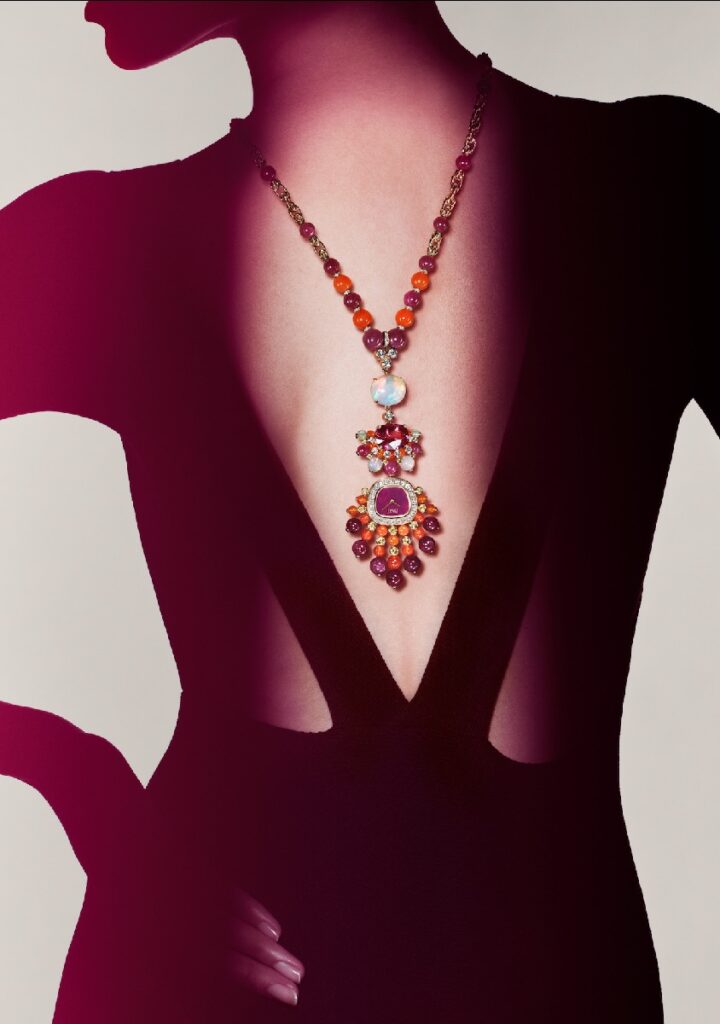
I have said so before, I know, but when it comes to watches and writing about them, it’s still beauty before brains for me. A year or so on from my stint as a judge at the prestigious GPHG, (Grand Prix d’Horlogerie de Genève), where I learnt so much I still tend to drift off, into daydreams, during explanations of the intricacies of horological marvels.
Although I can say, with no small amount of pride, that I do now get that it’s all about absolute precision, balancing the vagaries of gravity, adjusting to time zones, tracking the moon phases, counting nano-seconds, measuring ocean depths, and so much more than I will ever understand. Watchmakers do it, it seems, just because they can. And, rather vapidly perhaps, I have come to love the look of the movements, the wonderfully-named complications, their lace-like finesse, the cogs, wheels, knobs and dials, balances, escapements, pulsating oscillating weights. I find poetic choreography in their industrial beauty.
CHANEL Noeud de Camelia cuff watch in white gold, diamonds and lacquer
So honouring yet glossing over the wizardry of today’s awe-inspiring timepieces, I find I’ve fallen even more in love with jewellery watches; surely one of the most elitist, esoteric, and thrillingly innovative creative corners of our jewellery world, the corner between haute joaillerie and haute horlogerie. More fantastical year on year, moving far beyond the usual description of a jewel that happens to tell the time, the high jewellery watch has become the very definition of haute-luxe, exquisitely eccentric, the ultimate jewel-possession, a true object of desire. Today’s jewellery watch is conceived and crafted in true couture spirit: wildly imaginative artistry made possible by breathtaking recherché artisanship, with ultra-luxe materials and more than a flourish of fantasy, the kind of escapist wonder that has always been the prerogative of well-heeled connoisseurs and collectors. It’s the stuff of Wunderkammer. Perhaps this divine creativity is spurred on by the unstoppable mechanical innovations of the fast-moving watch world, or on the other hand, perhaps it’s the watch world wanting to rival and even outdo high jewellery.
Maybe it’s the challenge of transforming the science of horological engineering into a lyrical work of art, or maybe it’s simply a way of nurturing beauty and fantasy as a distraction from the relentless passing of time. Perhaps, too, like the brooch which invites endless imaginative artistry, the watch case and dial do not have the usual constraints of the jewel that has to fit the body; instead ornamentation is limited to a specific space, and the watch has only fit on the wrist, with plenty of scope for adorning the arm, if required.
VAN CLEEF & ARPELS Lady Recontre Céleste watch in white gold, diamonds, sapphires, mother-of-pearl, and enamel. The making of the Ludo Secret watch.
Whatever the reasons, to my mind, the jewellery watch still resonates with echoes of past grandeur and the elegant formality of cocktail parties and high society balls. A throwback to the ’50s Golden Age of Couture, or even earlier to the ’20s and ’30s, when social etiquette bred the need for the secret watch, allowing time to be glimpsed politely and surreptitiously. The watch masqueraded as a bracelet, the dial sheltering beneath a sliding bejewelled cover, or so minute (excuse the pun) it almost disappeared, as in Jaeger-LeCoultre’s famous 101 movement of 1929 that I adore. Or as in Van Cleef & Arpels’ Cadenas of 1935, modelled as a chunky padlock – supposedly the idea of the Duchess of Windsor – with a tiny dial set into the angled side of the lock, visible only to the wearer (one with good eyesight).
The Cadenas, so avant garde at the time, has become a design icon, another of my all time favourites, glamorous and timelessly modern. There’s an echo, too, of the 1970s, When Piaget’s milestone 21st century collection of spectacularly extrovert cuffs and sautoirs fused fashion, contemporary design and watchmaking, re-inventing the jewellery watch for a new age, making it modern, relevant and ravishing.
DIOR Grand Bal Jardin Parisien watch in white gold, diamonds, gemstones and mother-of-pearl
Today, in a cultural mood that seems headed towards ’70s style hedonism, escaping a world of chaos, time has never been so precious. Jewellery watches are pure theatre: shown to perfection in Dior’s luscious Grand Bal creations, with the oscillating weight ingeniously transferred from back to front, transformed into an enthralling kinetic decorative feature, suggesting the swish of a swirling 1950s Dior ballgown. The precision and hand-craftmanship to ensure the rotor is both exquisitely ornamented and the perfect weight to power the watch are mind-boggling – even I’m captivated by the technique. There’s old-school romance in Van Cleef & Arpels’ Poetic Complications, or modern retro-chie in the revamped Ludo Secret watch, and charming storytelling in Chanel timepieces that find new ways to celebrate Mademoiselle’s life and passions – the camellia, the bow, the accoutrements of the atelier – even reimagining her persona and style signatures as digital, pixellated characters. And Piaget, as ever, reignites the revolutionary audacity of the ’70s, its birthright, this year through the colour and texture of ornamental stones, the minerals and hardstones that became a defining feature of the 21st Century collection. Re-charging the creative dynamism that changed the course of watchmaking history, some 50 years ago, and could well be changing it again today.
VAN CLEEF & ARPELS Lady Retrouvailles Célestes watch in rose and white gold, gemstones, mother-of-pearl, and enamel.
For Issue 15 our resident jewellery historian Vivienne Becker unpacks how red carpet dressing has evolved and what it takes in the modern era – check it out below.
When Harry Winston lent diamonds to Jennifer Jones to wear at the 1944 Academy Awards ceremony, Hollywood jewels moved from the screen – where they’d played a starring role – onto the Red Carpet.
And there they have stayed, firmly and flamboyantly, ever since: an essential attribute of movie star glamour.
Today, celebrity Red Carpet dressing has grown into a major phenomenon of the jewellery world, an industry in its own right, backed by serious research, powered by strategy and, in many or most cases, plenty of cash.
The ever-proliferating Red Carpets of the world have become the most powerfully influential, far-reaching showcases of jewels and jewellers, building or burnishing the images of movie stars, models, and celebrities, while, at the same time, creating a lustrous halo for brands and Maisons.
Emma Beckett, Founder and strategist for EB Talent (the VIP division of EBPR) and who liaises between stylists, stars and the brands her agency represents, explains the process.
“There’s real science now behind Red Carpet dressing, huge amounts of research – the next year’s films, up-and-coming stars, the cultural calendar, chat rooms, agents, record labels, knowing which stars are moving to which stylists,” she explains.
“It’s crucial to identify a star or celebrity with traits that align with a brand. Through the right jewellery on the right person, a brand can even create its own cultural trends.”
Which is exactly what Harry Winston did, taking on the mantle of ‘King of Diamonds’, imbuing his jewels with regal allure.
An impassioned gemstone connoisseur and brilliant entrepreneur, he aligned his jewels with movie stars – the new American royalty – and tapped into the age of aspiration bred and fuelled by Hollywood and the Silver Screen.
Jennifer Jones with the Best Actress Oscar next to Ingrid Bergman – Credit: Keystone/Getty Images
With Jennifer Jones he had backed a winner: she won the Best Actress Oscar for her role in the 1943 movie, Song of Bernadette and as the flashbulbs popped, her diamonds glinted, sending her bejewelled image around the globe.
Having opened his own jewellery business in 1932, aged just 24, by the mid-1930s Winston had already harnessed the power of celebrity, when he photographed Shirley Temple holding the 726 carat Jonker rough diamond, which he then took on tour around the United States.
This was a curtain raiser to his 1949 touring Court of Jewels, showcasing historic gems, including the Hope diamond. It was marketing genius: engaging the public, drawing them into a previously untouchable, rarefied world of romance, glamour and wonder. It’s exactly what the Red Carpet does today.
Harry Winston jewels have continued to walk the Red Carpets. In 1998, 87 year old Gloria Stuart, nominated for her role in Titanic, wore a 15-carat blue diamond pendant and necklace, referencing the ‘Heart of the Ocean’, the priceless treasure worn in the film by Rose.
Most famously, though, Winston diamonds appeared on a tearful Gwyneth Paltrow in 1999, when she won for Shakespeare in Love: her parents bought the diamond necklace for her afterwards.
Gwyneth Paltrow at the Oscars in 1999 – Credit: Steve Granitz/WireImage via Getty
Today, Paltrow is dressed and bejewelled by super-stylist Elizabeth Saltzman, herself an avid and knowledgeable jewellery devotee. Fresh from working at the Governors Awards, in November, she says that “jewellery on the red carpet is not just a sprinkle of fairy dust.” She continues: “It can make or break a star’s image.
The right necklace can just be the ‘wow’ that draws you in.” When choosing jewellery for her clients, she thinks first and foremost about the person, and the story they want to tell, and whose confidence she hopes to build. “Sometimes I start with the jewellery, not the dress,” Saltzman continues.
“If something doesn’t feel right, I’m not afraid to say ‘no’. I can tell instantly what works, which jewellery makes the person feel their best, when the shoulders suddenly stand tall and strong, when the posture becomes regal.” Saltzman says that while she embraces what she personally loves in jewellery, (Verdura, Belperron, David Webb) she looks at a variety of different options, individual independent designers, brands and Maisons, and loves to mix vintage and modern.
Talking through the decision-making process of dressing Paltrow for the 2025 Governors Ball, she explains: “We sit together, discuss ideas and make a game plan. My job is to listen, to hear what’s going on in the client’s life. Gwyneth wanted to be cool and casual, a bit messy, so that it wasn’t so much about the jewellery and the dress, but about her, herself.
We chose Dries van Noten and very long black earrings by a young jeweller. So it’s easy to see the California girl that is Gwyneth.”
Nicole Kidman wears a necklace containing 7,645 diamonds totaling nearly 1,400 carats to the Oscars in 2008 – Credit: Chris Farina/Corbis via Getty Images
Maybe the casual, authentic look augurs a change in Red Carpet jewellery trends for 2026. There are certainly trends: in 2002, Nicole Kidman sparked a new mood of casual diamond opulence, when she wore a joyful jumble of rough diamond strands, all 241 carats, that wrapped around the neck and trailed down the back.
A collaboration between De Beers and Bulgari – for whom it was the first rough diamond creation – Kidman had apparently had a hand in its design.
She followed this in 2008 with another striking 1399-carat rough diamond draped necklace, designed by L’Wren Scott.
Then came the vogue for vintage jewels, the territory of Fred Leighton, New York, and Martin Katz and Neil Lane of Los Angeles, giving the wearer an aura of cultivated taste and individuality.
Keira Knightly wore a 1950s Bulgari coloured gem bib necklace in 2006, and Lady Gaga paired a vintage Flato ruffled cuff bangle from Neil Lane, with Lane’s own contemporary interpretation in 2016.
When Angela Jolie made a stunning appearance in 2009 in colossal emerald drop earrings by Lorraine Schwartz – (Queen of the Red Carpet jewellers) – she heralded the resurgence of emeralds, giving them a modern, cool born-again movie star glamour.
Lady Gaga at the 2019 Oscars wearing the 128.54 carat Tiffany & Co yellow diamond – Credit: Jeff Kravitz/FilmMagic via Getty Images
And when Lady Gaga stepped out again wearing the historic 128.54 carat Tiffany yellow diamond at the 2019 Oscars, she signalled a return to old school Hollywood glamour.
It was a Red Carpet moment, especially as she was only the third woman to have worn the legendary stone.
Aimee Croysdill, stylist to Nicola Coughlan, Erin Doherty, Marisa Abela and Milly Alcock says while “we went through a trend of big statement pieces”, she wasn’t “a fan”, instead “preferring jewellery to feel aligned with someone’s personality rather than something they feel they must wear.”
She continues: “Right now, a lot of high-end jewellery brands are offering beautiful fine jewellery that feels more modern or more classic, instead of the very traditional look we saw for a long time.”
“I love using ear cuffs, stacking, layering rings, a pinky ring or a cool thumb ring – pieces that feel like something you could wear day to day but that are elevated with diamonds, making them feel special without looking like you’ve dipped into your grandmother’s jewellery box. Right now, mixed metals feel fresh and modern.”
She explains her process. “Normally I have a really good sense of what my clients love. If someone loves a vintage aesthetic, I lean into art deco shapes, emeralds and clean diamond cuts. If they’re a bit more grungy, I’ll use ear cuffs, stacking or a simple choker.”
“If they’re more classical, I’ll choose more traditional pieces. Sometimes you find an incredible piece, but it just doesn’t work with the outfit, so you have to pull back. Other times, an outfit needs a star moment – a really spectacular piece or lots of layers to bring it to life. It’s about knowing when to lean on the jewellery and when to keep things minimal.”
Perhaps the strongest Red Carpet trend to emerge in recent years has been men-in-jewels, both mega-statement brooches and necklaces.
Colman Domingo was smothered in Boucheron at last year’s Golden Globes, Timothée Chalamet in Cartier at the 2024 Golden Globes and Adrian Brody going rogue with a brooch extravaganza by Elsa Jin at the Met Gala 2024.
At the 2025 LACMA Art+Film Gala, actor and designer, Damson Idris wore his own design, a brooch created for his brand Didris, the two gem-set elements joined by a chain, a clever hint of a gentleman’s watch chain.
Damson Idris wearing DIDRIS at the 2025 LACMA Art+Film Gala – Credit: Taylor Hill/FilmMagic via Getty Images
Suddenly it all looks absolutely right, and as Saltzman says, men have taken back the right to adorn themselves. “It’s the most exciting thing to happen on today’s Red Carpet; we’re back to Kings and Maharajahs style.”
Tiffany’s Schlumberger Bird on a Rock has been the go-to for male celebrities, as part of the company’s megawatt campaign of celebrity endorsement, starting with Beyoncé and Jay-Z and ensuring the Red Carpets around the world drip with Tiffany treasures.
So from the brands’ point of view, does it work? How much kudos does that Hollywood halo bring to a designer, brand or Maison, and most importantly does it offer up the holy grail of substantial return on investment?
And what exactly is that investment?
So great is the clamour amongst the world’s jewellers to claim the spotlight on the Red Carpet, awards season is always buzzing with talk of huge sums of money being handed over to stars.
According to Emma Beckett, roughly 50% of endorsement is organic and unpaid and 50% paid for. Saltzman works organically, so that she has the freedom to choose the jewellery she knows is right.
Although sometimes, she says, the situation becomes complicated if the client is a brand Ambassador and contractually obliged to wear jewellery by that brand.
Michelle Yeoh wearing Moussaieff at the 2023 EE BAFTA Film Awards – Credit: Dave Benett/Getty Images for Moussaieff
Moussaieff’s spectacular, flashbulb-popping diamonds have perfect Red Carpet appeal so that the independent London-based jeweller has had success, also working organically, most notably when Michelle Yeoh chose Moussaieff jewels in 2023: the year she won best actress for her role in Everything, Everywhere, All At Once.
Kim Kardashian is also a fan, borrowing sensational brown diamonds, necklace, earrings and rings to wear to last year’s Bezos- Sanches wedding, with its own Red Carpet extravaganza, and opted for white diamonds to wear at the 2025 Met Gala.
Chopard virtually owns the Red Carpet at Cannes, where Artistic Director, Caroline Scheufele, works personally with her top stars including Julia Roberts – a brand ambassador – and Julianne Moore, and where the Swiss watchmaker and jeweller invites top clients to preview their annual, aptly named Red Carpet collection, while immersing themselves in unadulterated glamour, walking the Red Carpet themselves.
Elsewhere, Chopard shimmers at galas, film festivals across the globe, working with various stylists with arrangements that seem to be fluid. There’s no doubt that Hollywood glamour, embedded in Scheufele’s audacious style, plays an integral part in Chopard’s image and commercial success.
For Martin Katz, Beverly Hills jeweller, Hollywood has completely shaped his brand, elevated his business, and made his reputation. He tells how in 1992, when he dealt mainly in vintage jewellery, a client in the movie industry asked if he would lend jewellery to a star, little known at the time.
He insisted over and over he didn’t loan jewellery, but when John Goldwyn, President of Paramount Pictures called to ask for a personal favour, he relented, asking for a credit in return, on all of the star’s promotional photoshoots.
The star was Sharon Stone, the film was Basic Instinct, and says Katz, “overnight I became a brand.” He explains, “the Red Carpet opened the door to everyone. Agents started calling. Previously, ever since the studios stopped supplying clothes and jewels, stars had worn only Armani and Harry Winston.”
Katz recalls how at the start of his Red Carpet adventure, before stylists were involved, he worked mainly with PR representatives, and they would decide between them. He muses: “In the old days too I would get thank you notes, but that doesn’t happen today.”
He says that paid endorsements took hold around 2002, changing the business of Red Carpet dressing, although he works only organically, and never pays for his jewels to be on the Red Carpet. He is sought after for his reputation as a private jeweller-to-the stars, with a penthouse by appointment salon in the Fred Hayman building, Beverly Hills.
“Today, we work mainly with stylists,” he explains. “They show us the dresses they have in mind, and we discuss possibilities and options. It’s important to get it right. When a star picks up a jewel that speaks to them, they wear it with confidence. You can tell instantly when someone has been told to wear something.”
Kate Winslet wearing vintage jewellery at the 1996 Oscars – Credit: Vinnie Zuffante via Getty Images
Since Basic Instinct, Katz has adorned a roll call of stars, including Kate Winslet who wore a vintage bib necklace in 1996 when she won the Academy award for Supporting Actress for her role in Sense and Sensibility. She has remained a fan, choosing Black and White diamond Art Deco style earrings to wear to the 2025 Golden Globes.
At the 2024 Emmys, Gillian Anderson also wore monochrome diamond Deco earrings, bangle and ring, while Robbie Williams wore an Art Deco diamond pin for the Golden Globes. Katz says, “I do it to stay relevant, not to sell, just to make a bit of a buzz, build brand awareness and keep the press interested.”
He adds however that he understands why brands pay for endorsement: “Hollywood still drives so many things. Why wouldn’t you throw money at the Red Carpet?”. Elizabeth Saltzman agrees, “Every Red Carpet is an audition”, she says, “It’s about showing yourself to the world.”
Flickering fantasies of unadulterated glamour, luxury and romance – the Silver Screen delivered pure escapism in its earliest days, and it was much needed during the Great Depression following the 1929 Wall Street crash.
Along with escapism came aspiration, as the burgeoning Golden Age of Hollywood Silver Screen opened a door onto a whole new world, and the movies, especially the new talkies, became not only storytellers but scintillating showcases of modern style.
Hollywood exerted a massive influence and the lavish sets, dreamy costumes, and opulent interiors shaped a new American cultural identity. Jewels, the ultimate aspiration and symbols of success, played a starring role in this identity: they were an essential element of Hollywood’s intoxicating allure.
Jewels on screen grabbed the cultural limelight, inextricably linked, now as then, to classic movie star glamour.
I came to understand how the Silver Screen had influenced jewellery style – think of Jean Harlow, with her white-blonde hair and clingy oyster-hued satin gowns and the mid-20s vogue for all white jewellery, of platinum, rock crystal and diamonds.
Now, as old-school American glamour is again having a moment, watch Golden Age movies with a keen eye on the jewellery.
Just the other day, I spotted the Cartier rock crystal and diamond bracelets, similar but not identical, worn, sumptuously stacked on Gloria Swanson’s wrist in Sunset Boulevard, 1950.
They were her own bracelets, purchased from Cartier, just as many movie stars of the time bought their own jewels, and wore them both on and off screen. Much more than surface ornament jewellery became a vital, vibrant, awe-inspiring part of their persona.
My favourite Hollywood jewel is Marlene Dietrich’s daringly dramatic ruby and diamond jarretière cuff bangle, commissioned from Van Cleef & Arpels in 1937, from gems she already owned, and often worn by the Blue Angel, including in Hitchcock’s 1950 film, Stage Fright.
A masterpiece of late ‘30s jewellery design, embodying the spirit of Hollywood, the taut, tailored silhouette, voluptuous volume and luscious expanse of rubies combine to make the perfect expression of Dietrich’s inimitable androgynous glamour, with its blend of sensuality and ferocity.
Marilyn Monroe on the set of ‘Gentlemen Prefer Blondes’, directed by Howard Hawks – CREDIT: Sunset Boulevard/Corbis via Getty Images
From the roll call of ravishing Silver Screen jewels, I just have to mention the Moon of Baroda, the 24 carat yellow Golconda diamond, worn by Marilyn Monroe to promote the unforgettable jewel-toting 1953 film, Gentlemen Prefer Blondes.
In all, what I love about the story of Silver Screen jewels is the way in which it reveals how Hollywood fuelled and nurtured a distinctive home-grown American jewellery style, extrovert, spotlight-grabbing, unashamedly uninhibited in scale and sumptuousness, hypnotic jewels to get you noticed, to embody the magic and majesty of the movies: the heart and soul of American glamour.
In the modern era of multiple, lavish red carpets per blockbuster film, the variety of design and use of iconic pieces of the past has shown jewels will always be able to steal the spotlight.
Emerald Fennell’s ‘Wuthering Heights’ film is filled with extravagant jewels and fashion to match the intended tone. The press tour has seen star Margot Robbie adorn both classic and custom pieces in reference to the themes on display.
As for the Los Angeles premiere, she wore a stunning Schiaparelli couture dress accompanied by a heart-shaped Taj Mahal diamond, which once belonged to Elizabeth Taylor, in a Cartier necklace.
The necklace tells a much more historical love story, as it was originally a gift from the Mughal Emperor, Shah Jahangir to his wife Nur Jahan. It features an inscription in Parsee which reads “Love is Everlasting” along with Nur’s name alongside it.
Jewels have been used as their own form of storytelling throughout history on screen and in relation to cinema. With Robbie’s styling showing this through ‘Wuthering Heights’ and other ventures such as ‘Barbie’, the emphasis on jewels relating to themes and aesthetics of singular cinematic experiences seems to growing.
All of this showing that jewels on screen continue to be in the spotlight.
This is turning out to be something of a love letter to the colour pink; an ode to the intoxicating hues and startling brilliance of the Argyle pink diamond, now taking its place in history as a rarefied and storied heritage gemstone.
Ever since the exquisite, enigmatic candy-pink coloured diamonds first appeared on the market in the mid-‘80s, when I gazed puzzled and intrigued at a cute pink-paved Koala bear brooch in Graff’s Knightsbridge window, I’ve followed the shimmering saga of the Argyle pink diamond, through the story of its discovery in 1979 via an anthill in remote Western Australia through its glamorous starring role in high jewellery and elevation to the connoisseur’s ultimate possession right up to the closure of the mine in November 2020.
A selection of natural diamonds from the new Beyond Rare tender comprising a unique combination of pink, red, violet, yellow and white polished diamonds (Photo: Argyle Diamonds Pty Limited 2024)
Throughout I watched as the coloured diamond was metamorphosed from a geeky, glass-case specimen into a fashion-forward object of desire. For me, it’s been living history, experiencing, at first hand, one of the most important, industry-defining milestones in the story of the divine diamond, a mega-moment in jewellery history.
I’ve been lucky enough to see and handle some of the most astonishing specimens from the Argyle mine, the sweet, intense purplish-pinks of a shade and saturation never before seen, the ravishingly rare reds, aristocratic powder-blues, and mesmerising violets – especially the Argyle Violet, a deep greyish-bluish violet with its compelling mix of light and shadow. (now owned by L J West, New York diamantaire and Argyle Pink Diamond specialist.)
Hirsh Argyle pink diamond necklace
I’ve loved exploring the full spectrum of Argyle diamond shades, peach, champagne, cinnamon, bronze,cognac, with their clever, emotive names, and seeing how this entirely new palette of colour and light enticed designers into creating a new style of young, modern, casual diamond opulence. And witnessed a historic happening (and a memorable milestone in my own story ) when in 2019 I visited the mine site in the remote, vast, red-earthed wilderness of East Kimberley, Western Australia, (complete with snakes and frogs in the toilet) to be present at the reveal of that year’s collection of the rarest, most important, most desirable stones, one of the last selections to emerge from the mine before its closure the following year.
Before the Argyle mine came on stream, in 1983, pink diamonds were only found very sporadically, in various mines in India, Borneo, Brazil, Africa, Indonesia and considered an anomaly, a wondrous fluke of nature. So much so that some of the world’s most famous, most historic diamonds are pink, including the Agra, an early Mughal treasure and the Williamson pink, set into a Cartier flower brooch, one of the favourite jewels of our late Queen Elizabeth II.
Queen Elizabeth II’s Cartier Williamson brooch, set with the Williamson pink diamond (Photo by Cole Bennetts/Getty Images)
The Argyle mine however delivered a consistent source of these rarities, diamonds of exceptional fire, life and brilliance and an unprecedented, unique shade and depth of pink. But while the mine itself was vast, only a minute proportion of its production was classified as pink: of some 15 million carats of rough produced each year less than 1% was pink, making these stones unfathomably rare, and consequently madly desirable, the ne plus ultra of gem collecting. Earlier this year, Laurence Graff acquired the Argyle Phoenix, a 1.56 carat red diamond, for a record price of $4.2 million.
The source of their colour, believed to be the result of atomic distortion, or deformation of the atomic lattice or make-up of the diamond, still remains something of a mystery, which adds to the intrigue and enchantment. What is known is that the stones were formed 1.6 billion years ago, deep in the earth, in this extraordinary wild stretch of land, sacred to its indigenous people.
Queen Elizabeth II wearing the Cartier Williamson brooch in 1977 (Photo by Fox Photos/Hulton Archive/Getty Images)
People who have passed down legends about the land and woven creation myths around the buried treasures it has bred and nurtured. People who, by the way, have benefited from the fruits of the mine, and from Rio Tinto’s enlightened, responsible approach to mining, involving the leaders of the community, including their people in the workforce, training them for employment after the end of the mine’s life. Now Rio Tinto is engaged in a decade long process of rehabilitating the land, in accordance with the wishes of the people.
Recently, in London, I went to see the latest collection of Argyle ‘Tender’ stones, the rarest diamonds that are carefully selected, curated and offered to an invited list of diamantaires, jewellers, collectors, fund managers etc who submit closed bids. The collection includes specimens from the remaining inventory plus some ‘Old Masters’, Argyle Pink Diamonds from past Tender collections, keeping the brand and story alive, preserving its legacy, through custodianship of the secondary market.
David Morris Pacifica ring
It’s the start of a new chapter in this saga, true, but what hit me most forcefully was the sensation of awe and wonder I felt at seeing these miraculous natural treasures; each small, perfectly-formed but with a potent emotionally-charged presence, imbued with an otherworldliness that comes partly from provenance, from the sacred land, and from the knowledge of the randomness of elements, and cataclysmic geological forces at the birth of the cosmos that came together to create such astounding beauty and rarity. Beauty, light and colour, unleashed by man’s skills and understanding of nature.
There’s something unknowable, unfathomable about these diamonds that captivates me. And it made me think, once again, about lab-grown diamonds, which after all have their own creation story – man’s ingenuity, science and the sexiness of the laboratory – and a certain appeal to younger generations.
A rare pink Argyle diamond (Photo by Emmanuel Dunand/Getty Images)
It seems to me, in the face of today’s assault on the natural diamond industry by the lab-grown fraternity, that the Argyle Pink Diamond, mysterious, mesmerising, miraculous, bringing hope and prosperity to future generations of the traditional owners of the rugged, red-earthed land, has all the answers: showing and telling how and why for millennia the diamond has enchanted us, prized as a spiritually-imbued treasure, encapsulating the soul and spirit of the earth and the light of the divine. Let the legend live on.